11.18.2023

Vintage DSLR Pics: Kit Cars with the Canon EOS-1D Mark III


Here are a pseudo Bugatti Type 37 and a faux MG TD tooling around the 'hood. Both are Beetle-powered, although the Bugatti is a much more extensive alteration of the original VeeDub.


Both were photographed with a 2007-vintage Canon EOS-1D Mark III & EF 24-105mm f/4L IS zoom lens.

.

11.16.2023

Comeback Trail for Cameras?

Indiana State Fair attendee with a Canon EOS 80D & Tamron 18-400mm zoom lens.

Something I noticed at the State Fair this past summer was that there were a lot more people carrying actual cameras... you know, the kind you hang on a strap around your neck ...than there have been for the last several years. I probably haven't seen this many serious cameras being used in the entire time I've been attending the Fair.

A shutterbug friend attending a Highland Games event out east last month also noticed an unusual number of cameras, real cameras of the interchangeable lens variety, relative to what he'd been used to of late.

Heck, on the random street corner I picked to stake out the Monumental Marathon here in Indy the other day, among the people waving cell phones, was a young shooter with a Canon Rebel T7 and kit lens.

That got me to wondering why this is, and here’s my theory:

Up through the end of the film era most people had some sort of camera, but unless they had photography as a hobby, it was generally only used to document special occasions: holidays, parties, holiday parties, vacations, sports games or concerts...that sort of thing.

This was because of two things. The first was that each photograph had real physical monetary and time costs, in film and processing and printing. The second was that in order to share those images with anyone, you had to be in the same place with them and get them to look at your physical photo.

The flash-burned photo of me leaning on the trunk of my '75 Ford Granada sedan* was taken with a Kodak S1100XL just like the one in the photo, back in '91.

That changed with three innovations that became increasingly common toward the end of the Nineties: Digital cameras, the World Wide Web, and broadband connectivity that could transmit images to your screen at something other than a snail's pace. (One of the first web fora on which I was a moderator would close and lock threads once they went over 100 kilobytes in size so that they wouldn't load too slowly for people on dialup connections.)

With the ability to share photos over the internet, the reasons to purchase a digital camera began to multiply. I remember on my first AOL home page what a pain it was to take physical photos and then get my then-roommate to scan them so they could be put online.

The new horizons of eBay and Craigslist gave normal folks who'd never consider photography as a hobby or pastime a reason to buy a digital camera. How are you gonna sell that sofa or old Honda unless you can upload some photos of it?

In fact, the need to sell my old '84 Trans Am was the impetus for the purchase of my own first digicam, a New-Old-Stock Sony Mavica FD-88 in October of 2001. The fact that I could use it to take pictures of S&W revolvers and upload them to internet forums was just a bonus. Ironically, I picked the Mavica not only because it was on sale, but also because it stored photos on floppies. Back then, there was no standard storage medium for cameras: Memory Sticks, SD and CF cards, SmartMedia, xD cards... they were all vying to be The One. I picked the Mavica because computers would always have floppy drives, right? Ell. Oh. Ell.
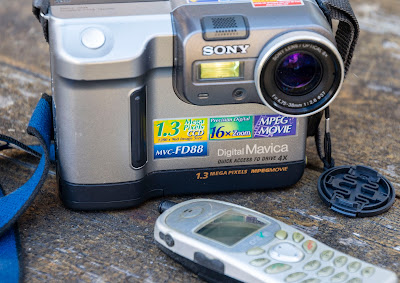
You never forget your first digicam or your first cellie, I guess...

Over the next few years I upgraded digital cameras twice, first to a Nikon Coolpix 990 in 2003, and then a Kodak EasyShare V1073 in 2008. I was still using the Kodak when I got my first smart phone in 2011, an LG Optimus V, whose 3MP camera was no threat to the supremacy of the EasyShare with its 10MP sensor and sharp Schneider-Kreuznach 3X optical zoom lens.

My next phone with a camera was a Samsung Galaxy SII and, to be perfectly honest, if I hadn't gotten back into photography as a hobby, that's where I would have stopped buying cameras. The Galaxy's camera had an 8MP sensor and turned out perfectly adequate snapshots.

Here's the thing, though: That generation of smart phones... the Galaxy SII and the iPhone 5 ...put perfectly adequate snapshot cameras into the hands of millions of people, some percentage of whom eventually wanted more. Being on Instagram or Flickr can expose a person to some pretty cool imagery of the kind that can't exactly be duplicated with a fixed 24mm lens and a 1/2.3" sensor.

Dozen-year-old cameras are still useful, unlike dozen-year-old smart phones.

Just like back in the film days, some people got their start with a Brownie or an Instamatic and decided that they liked taking pictures and wanted to be able to do more, a certain percentage of folks are using the modern-day equivalent of those ubiquitous snapshot cameras...and deciding that they want more.

Will digicam sales ever return to what they were? No, but only if you count the standalone inexpensive general purpose digicams. People don't need those anymore, because there's already one strapped to their phone.

But cameras for the specialized activity of photography are still with us, and maybe having a bit of a revival. After all, it's never been easier to share your photos than it is right now.

What about you? Have you noticed an uptick in actual cameras where you are?
.


*EDIT: My bad, my memory had failed me. The brown ’75 Granada was a coupe, not a sedan. It may have been a depressing six-cylinder crapbbox bought for two hundo as basic transportation at what was maybe the low ebb of my life to date, but I still had standards, dammit.

Fujifilm XQ1 review: Thumbs Down

So there was this time I fell in love with a pocket digicam, only for it to break my heart.

On paper, the Fujifilm XQ1 was my perfect pocket camera: The lens collapsed flat and the whole thing was the size of a deck of cards. It had a ginormous (for a pocket cam) 2/3" sensor. It had a 24-105mm equivalent zoom lens with a bright f/1.8-4.9 maximum aperture. It had those lovely Fuji colors and could shoot RAW with the full array of PASM modes.


It took great pictures!


Alas, the XQ1 has a known bug in that the aperture blades tend to get stuck wide open, and the camera's basically bricked when that happens, because it's long past the time when Fuji could repair it.

Get a Sony RX100 instead, the original one, used. Just as good a lens, same focal length range, bigger sensor.

.

11.15.2023

Vintage DSLR Pics: Motorcycle Action with the Canon EOS-1D Mark IV

The EOS-1D Mark IV, launched in autumn of 2009, was Canon's last pro DSLR to use the APS-H size sensor. This sensor was slightly smaller than a full-frame 35mm negative, giving a 1.3X crop factor, and was intended to offer higher frame rates for sports shooting.

The early Canon pro bodies came in pairs. The original EOS-1D had a 4MP APS-H sensor and could shoot at 8 frames a second until the buffer filled, while the EOS-1Ds had an 11MP sensor the same size as a 35mm negative, but could only manage about 3fps and filled the buffer much faster with its enormous image files.

So the larger sensor cameras were marketed for studio and landscape work while the higher frame rate APS-H bodies were aimed at photojournalists as well as wildlife and sports photogs. The 1D Mark IV, for instance, started shipping a couple months before the 2010 Winter Olympics in Vancouver and the timing was not a coincidence.

While the 1D Mark IV was the apex predator of the Canon lineup when it was new, sporting a $5000 price tag to match, used ones these days are obviously much cheaper, available for as little as $400 from KEH. The samples to look for, though, are the extremely good condition ones with low shutter counts. 

A friend calls those "Doctor Cameras", referring to the well-heeled enthusiast photographers who buy the top-of-the-line pro gear, designed and engineered to give years of hard use and hundreds of thousands of shutter actuations, and then use it very little before flitting off to the next Ultimate Camera. Those buyers are a boon to us Poors who like to play with high end gear, as they inevitably clean out their camera closets every few years and sell the stuff to resellers like Roberts, MPB, or the aforementioned KEH.

It's kind of ironic to use a high-speed sports camera to take pictures of motorcycles from my usual perch at 54th & College in SoBro. It's not really a spot for action photography, being a flat four-way intersection in the middle of a city...but sometimes I get lucky!

These were all shot with the 1D Mark IV and Canon's EF 24-105mm f/4L IS lens.


11.14.2023

Digicam Pics: Autumn Colors with the Nikon Coolpix P7000

I've had the little Nikon Coolpix with me as I was walkabout in the neighborhood the last few days. We're past the peak of fall colors, but it's still quite scenic out there.


This house's decor is always on point and changes from month to month: black and white checkered flag motif in May for the 500, rainbows in June for Pride Month, star spangled red white and blue in July, spooky in October, and this harvest motif in November...


11.13.2023

Digicam Pics: Around SoBro with the Samsung TL500

The TL500 from Samsung... yes, Samsung was in the digital camera biz for a hot minute ...was their 2010 offering in the "Enthusiast Compact" segment.

Like most enthusiast point & shoot cameras of the period, it offered a physically larger 1/1.7" 10MP CCD sensor, which offers better low-light performance than the more typical 1/2.3" sensor found on P&S.

The star feature on the TL500, though, is the glass. Samsung used German optics company Schneider Kreuznach as their OEM glass provider, and the lens on the TL500 is quite a showboat: It's a 5.2-15.6mm f/1.8-2.4 zoom lens. That's the equivalent of a 24-72mm lens on a full-frame camera with a bright f/2.4 aperture available even at the long end.

Here's the SoBrosaurus at wide-angle...


Here's the full 72mm equivalent zoom on the dino's noggin...


Here's a 100% crop of the second photo. Notice the good detail on the rusty metal surfaces...


I love the color rendition from these old 10MP CCD sensors!


In addition to the usual JPEG filters offered by P&S cameras, enthusiast cameras like the TL500 offer the full array of PASM modes and the option of shooting in RAW. The TL500 even has dual control wheels (a click wheel on the front grip and a rotary dial that doubles as a 4-way D-pad on the back) just like a prosumer DSLR. That's important if you want to shoot in full Manual mode, since one controller handles aperture settings while the other controls shutter speed.


11.12.2023

Mirrorless Pics: Pontiac Trans Am with a Canon EOS M

A couple years ago, I tagged along to the Indianapolis hamfest at the Marion County Fairgrounds. In case I saw anything that needed photographing, I brought along a Canon EOS M with the EF-M 18-55mm f/3.5-5.6 kit zoom mounted.

Sure enough, there was something to photograph, right there in the parking area!


Despite fitting in the palm of your hand, the big 18MP APS-C sensor of the EF-M delivers DSLR-quality images. I mean, essentially it's a EOS Rebel T4i with the mirror box and optical viewfinder removed.


This is a 1979 Trans Am, with the 10th Anniversary Y89 option package.


As Sammy Hagar sang in "Trans Am (Highway Wonderland)", '79 was the end of the road if you wanted horsepower overload...at least for a while. That was the last year for the big motors in the Pontiac F-body pony cars.

The fact that the hood scoop decal reads "6.6 Litre" rather than "T/A 6.6" means that it has the 185bhp Oldsmobile-sourced L80 403cid engine, instead of the optional 220bhp W72 Pontiac 400 cube V8. For the following model year, the only performance motors in the Firebird were the Chevy 305 or a turbocharged Pontiac 301.


11.11.2023

Mirrorless Pics: Portraits with the 1 Nikkor 32mm f/1.2

Easily the best lens in the entire lineup for the CX-format Nikon 1 mirrorless system, the 1 Nikkor 32mm f/1.2 is the equivalent of an 85mm lens on a full frame camera.

Despite the tiny 1" sensor, the f/1.2 maximum aperture can even manage a bit of background separation.


85mm is a classic focal length for portraiture and when you shrink it down to match the Nikon 1 format and put it on a little camera like a 1 V1 or V2, it doesn't feel as intimidating for subjects as would getting up in their grille with a big full-frame 85mm f/1.4.


11.10.2023

Digicam Pics: Around SoBro with the Nikon Coolpix P7000

Over at Down the Road you'll find a review of Jim Grey's workhorse digicam, the Canon Powershot S95. I can really relate to his enthusiasm for the camera, because it mirrors mine for the Nikon Coolpix P7000. (In fact, the cameras are in such a similar market niche that they were both in a three-way comparison test at DPReview.)

These days, when I almost always have an actual camera on a strap around my neck, the P7000 (it's my second!) doesn't get as much lovin', but I had it out yesterday.


The 6-42.6mm f/2.8-5.6 lens has a field of view equivalent to a 28-200mm zoom on a full-frame camera and a reasonably bright maximum aperture at the wide end.

At 200mm full zoom, the built in vibration reduction in the lens is plenty to offer a nice, crisp view of the SoBrosaurus's noggin, with good surface detail


Check out this mean-looking Audi SQ5 I saw yesterday!


I think I'll carry the P7000 around for a few days and see what it can see...


11.09.2023

Mirrorless Pics: Huck the cat with a Fujifilm X-E1

Huck, the Miniature Broad Ripple Biting Tiger

The X-E1, released in late 2012, was their second mirrorless camera, after the widely-acclaimed X-Pro1. Dispensing with the X-Pro's expensive hybrid electro-optical viewfinder, the X-E1 had a high-res OLED electronic viewfinder instead, but shared the same 16MP APS-C X-Trans CMOS sensor with its pricier stablemate.

Both photos were taken using the Zeiss Touit 32mm f/1.8 lens.

Holden, the Northern Floofloaf


.

11.08.2023

Good enough...for what?

I shoot a lot of old digicams for fun, but I also get a lot of actual work done with cameras that are technically obsolete.

Gettin' paid with a D7100 (upper left) and a 40D (lower right) in 2022.

When cameras stopped being light-tight boxes with a strip of photosensitive chemicals on a substrate and became light-sensing computers, they fell victim to Moore's Law.

Through the final decades of the film era, it was entirely conceivable that a working photographer could have used the same camera for decades, if not a whole career. While photojournalism, sports, nature, and that sort of photography naturally gravitated to motor drives, autofocus, and other advances as they matured in the Nineties, there's no reason that someone couldn't have soldiered through their entire career in product photography, landscapes, fine art, et cetera, with the same gear they'd always used.

Meanwhile in the digital era it was not uncommon for people to upgrade every three or four years.

While there has been a massive upgrade in capabilities, at what point is it good enough? And good enough for what? Or who?

I got to thinking about that while reading a recent piece by Thom Hogan:
I've written about "good enough" before, but I realize that I haven't pointed out the real problem with "good enough": it's a time-sensitive, subjective analysis based solely upon how well trained and experienced you are. Moreover, since we're talking about seeing things with our eyes, your eyesight also comes into play.
This is an entirely foreign notion of "good enough" to me.

My flippant and cynical response is "I know it's good enough when I see it in the magazine and the check clears" but that's just being snarky. I mean, if you're comparing lenses, sensors, monitors, et cetera, you need some sort of standards, and sharpness and color reproduction are things that are quantifiable.

On the other hand, this photo isn't super sharp at the corners and people are going to remember who Henri Cartier-Bresson was long after they've forgotten anybody currently blogging or vlogging or social media influencing about photography.

My photos are good enough for me if they convey the image I need them to convey. The camera or lens are practically incidental, so long as they're physically capable of capturing that image.

Huck expresses his opinion of meaningless increments of precision to a Nikon Coolpix P7000


.

11.07.2023

Vintage DSLR Pics: Puppers and Doggos with the Canon EOS 40D


In the beer garden behind Half Liter on Sunday afternoon were plenty of good doggos.

Fortunately I had the Canon EOS 40D and EF 24-105mm f/4L IS along with me that day! Thanks to the 1.6X crop factor of the 40D's APS-C sensor, the lens acts like a 38-168mm lens, which gave plenty of reach for pupper portraiture.


Mirrorless Pics: Around SoBro with the Pentax Q

The tiny little Pentax Q came out in 2011, touted as the smallest interchangeable lens system camera, and it is twee indeed. It vibes like an update of Pentax's old 110 SLR system.

Pentax Q with a Nikon D700 for scale.

The Q system numbers its lenses, and the first two released were the 01 Standard Prime, which is an 8.5mm f/1.9, and the 02 Standard Zoom, which is a 5-15mm f/2.8-4.5. Both lenses have built-in leaf shutters.

Constructed with a very solid-feeling aluminum body, the Q has a 1/2.3" sensor, of a size more commonly associated with pocket point & shoots and cell phone cams. Thanks to the tiny sensor's crop factor, that gives the 01 Prime the equivalent field of view to a 47mm lens on a full-frame camera, and the 02 Zoom a 28-83mm equivalent field of view.

Here's the SoBrosaurus at the widest angle with the 02 Zoom...


...and here it is zoomed in to the maximum 15mm:


These were both shot in RAW and just run through the Photoshop converter by poking the Lens Correction, Adobe Vivid, and Auto buttons.

Here are a couple more pictures from my walk yesterday, both using the 02 Standard Zoom lens:

SoBro apartment door

BMW X3 M4.0i


.


11.06.2023

Which to buy: Nikon Df or Nikon D4s?

Jim Grey at Down the Road posted another batch of photos from his Nikon Df today.

I've had a low-key hankering for one since the first time I saw it. It used to be because I pined for classic dial & knob controls, but that was before I really learned to use the wheels on a modern DSLR. (There's a reason that pro cameras have used the dual wheel setup since the days of the Nikon F5 and Canon EOS-1 film cameras, and it's not because professional sports photographers can't figure out knobs and dials.)

My hankering for the Df, therefore, is purely nostalgic these days, but there's another reason for it.

I use Canons for work, so my old Nikons are purely for fun. Because of that, I'm not going to dump a ton of money into Nikon lenses. And because of that, there's only one lens I own that really works well on my Nikon D800: the 24-120mm f/4G VR. The D800 is a fantastic camera, but the 36MP sensor really reveals the weaknesses of cheaper lenses, especially non-stabilized ones.

The 16MP sensor in the Df would offer more resolution than my D3 or D700 while still working well with older/cheaper glass.

There was a time, not too many years ago, when prices on used Nikon Df bodies had slumped down around nine hundred bucks or so. I should have bought one then.

These days, prices on the collectible Df have crept up to the $1200-1300 mark. Meanwhile, prices on the Nikon D4 and D4s pro bodies have slipped below a grand. Heck, you can get a D4 for under $800 if you shop around.

The D4 has the same 16MP sensor as the Df.

The Df has those vintage looks and old-fashioned knobs. The D4 has everything else: Rugged pro body construction, twice the frame rate in burst mode, a monster battery, the vertical grip and shutter release, et cetera.

When I first started pricing them, it was the D4 that was way more expensive and the Df made sense. With the price tags swapped out, however, the D4 is looking like the no-brainer for me.

Plus I have a real weakness for pro bodies.

Which would you pick?

.

Mirrorless Pics: Lotus Evora GT with the Nikon 1 J4


Two shots of a Lotus Evora GT with the Nikon 1 J4 & 1 Nikkor 10mm f/2.8 lens.


11.05.2023

Give it up, Panasonic.

For years people bought cameras manufactured by Ernst Leitz GmbH, but everyone called Leitz camera "Leicas". In fact, that's the official name of the successor corporation.

Similarly, when one purchased a camera manufactured by the Asahi Optical Company in Japan, one referred to it by its trade name, "Pentax". The "Pentax" name was actually purchased from Zeiss, and is a portmanteau of "Pentaprism", for the viewfinder mechanism, and "Contax", itself a trade name for a line of Zeiss-manufactured cameras.


So when the Matsushita Electric Industrial Corporation got into the camera biz, they wanted a catchy little name for them, too. I mean, they should be pretty good at it, since all their consumer goods were sold under the "Panasonic" name, and Panasonic home hi-fi equipment went under the "Technics" brand, in a sort of Russian nesting doll of obfuscation.

So Panasonic hung the "Lumix" name on their cameras. Every Panasonic camera has "LUMIX" in big letters right on the front of it.


But I've never heard anyone call them that. Ask a Micro Four Thirds loyalist shooting his shiny new Lumix G9 II and ask him what kind of camera he's using and it's dollars to donuts he'll answer "Panasonic", despite the label blazoned in half-inch tall letters across the front of the viewfinder hump.

Just own the Panasonic brand, guys. After all, it's been the official company name since 2008.

.