Showing posts with label Sony Mavica. Show all posts

9.16.2025

Soulless?


I’m not really a huge fan of any one camera brand, nor am I really a hater of any. I’ve used and enjoyed all kinds of cameras, made by numerous manufacturers.

I will say that the only one that I’ve felt any antipathy toward is Sony. Don’t get me wrong, they make fine photographic appliances, but so many of them feel like just that: an electronic appliance for making photos. The only Sonys I’ve really bonded with in any way so far are the a700 DSLR, which hardly counts since Minolta did most of the heavy lifting on that one and Sony basically showed up in time to slap their name on it, and the wonderful little RX100 pocket camera.

Other than that, I’ve used Mavicas and CyberShots, NEX mirrorless bodies, as well as using an a7 and an a7 II as my work cameras for most of a year, and just never really warmed to any of them. Their menus and interfaces always feel like they were designed by someone who transferred over from the clock radio or stereo division last week.

I mean, Canons and Panasonics are pretty soulless, too, but not in that way.

You know who knows how to really nail that camera vibe? Fujifilm. They’re probably the best at it these days. Olympus and Pentax, too. They’ve got the whole camera vibe thing figured out. When you’re using one of their camera, you know that there were serious camera nerds involved in the design of the thing.

Of the big two classic Japanese camera makers, Nikon does it way better than Canon, but their attempts at retro ring hollow when compared to Fuji’s.

4.19.2024

Blast from the past...

An ad from a 1999 issue of FamilyPC magazine for the new Sony Mavica digital camera!


1.30.2024

Re-Shoots

I used the Amazon gift card Bobbi gave me for my birthday to order a used Kodak Easyshare V1073.

Now I have a copy of each digicam I used before getting my first DSLR:
  • Sony Mavica FD88
  • Nikon Coolpix 990
  • Kodak Easyshare V1073
  • Canon PowerShot SX500
Now to go back and see if I can reshoot some things I shot back in the day, using the same gear, but do it better! The arrows are the same, but the Indian's gotten a bit better over the years, or at least I'd like to think so.

Alas, I won't be able to re-do the Lucky Gunner Blogger Shoot, or Knob Creek, or classes with Louis Awerbuck and Todd Green, or...

Kodak Easyshare at Knob Creek in 2011


1.03.2024

Disc Pics: The Sony Mavica MVC-CD300

At the dawn of the digital era there was still uncertainty as to which storage media would dominate. Compact Flash took an early head start, but the storage wars raged for a few years there.

Sony actually had a successful line of early digital cameras that recorded photos and video on 1.44MB 3.5" floppy discs. Thing is, those floppy discs that could hold a reasonable number of 640x480 shots started looking pretty insufficient as sensor resolutions raced past the megapixel mark around the turn of the millennium.

Sony briefly experimented with cameras that used 8cm CD-R discs, beginning with the Mavica MVC-CD1000 which they announced in the summer of 2000. The CD1000 sported a two megapixel sensor which meant you could get better than seventy JPEG images on a 156MB CD-R, as opposed to the three 1.3MP images my Mavica FD88 can squeeze onto a floppy.

At the time, the big advantage that Sony's floppy disc and CD-R Mavicas offered was the ability to transfer photos to nearly any computer via sneakernet. With other digital cameras of the era, you either had to have a card reader, which were far from ubiquitous, or you had to laboriously cable the camera to the computer via USB. On the other hand, almost every desktop and laptop of the time had a floppy drive, a CD-ROM, or both.


Above is the Mavica CD300, a 3MP camera from early 2001, representing the second generation of Sony's CD-R cameras. As you can see, within a single year, the resolution of cameras had jumped by 50%, from the 2MP CD1000 to the 3MP CD300.

The handwriting was on the wall for disc cams almost from their launch. The last generation of CD-R Mavicas came out in February of 2003, by which time the 5MP CD500 was down to fifty JPEGs per disc and, unlike the constantly growing capacities of Compact Flash and SD cards, CD-R capacity was fixed. The disc era only lasted six years, from 1997 to 2003.

.

11.21.2023

Physical Deterioration, Digital Decay

Over at Down the Road, Jim Grey is scanning some negatives he took back in 1982, pictures of friends and memories from his high school days.

This hits a note for me, because I have a huge box of negatives in the attic from my peak photography days in 1990-1992. I was working in one hour photo labs and as a photographer's assistant, and so I got discounted film and prints and free processing. Well, technically processing was supposed to be discounted, too, but no manager I ever worked for cared if you ran your film through the processor during a lull in the workday or charged you to do so, since there was no actual cost to the company for it.

The funny thing is that most of my earliest digital photographs, from the early Mavica days in late '01 up through probably 2007 or so, are inaccessible to me right now. Anything I kept saved to a hard drive is quietly succumbing to bit rot on a dusty Celeron tower in a cobwebby corner of the attic. Anything I didn't save to HDD, well... who knows where those floppies are, assuming I even bothered to save them through two moves?

I've been a much better digital custodian since then, and have photos saved to multiple places, but I really should get a proper on-site RAID setup, rather than using just the single external HDD I am now.


I should also look into scanning some of those old negatives. I mean, I've got photos of Lance Armstrong winning the First Union Grand Prix in Atlanta, his first big race win, in there someplace.

I don't know whether I should get a proper scanner, or just a simple light table and use my phone for a scanner, though...

.

11.16.2023

Comeback Trail for Cameras?

Indiana State Fair attendee with a Canon EOS 80D & Tamron 18-400mm zoom lens.

Something I noticed at the State Fair this past summer was that there were a lot more people carrying actual cameras... you know, the kind you hang on a strap around your neck ...than there have been for the last several years. I probably haven't seen this many serious cameras being used in the entire time I've been attending the Fair.

A shutterbug friend attending a Highland Games event out east last month also noticed an unusual number of cameras, real cameras of the interchangeable lens variety, relative to what he'd been used to of late.

Heck, on the random street corner I picked to stake out the Monumental Marathon here in Indy the other day, among the people waving cell phones, was a young shooter with a Canon Rebel T7 and kit lens.

That got me to wondering why this is, and here’s my theory:

Up through the end of the film era most people had some sort of camera, but unless they had photography as a hobby, it was generally only used to document special occasions: holidays, parties, holiday parties, vacations, sports games or concerts...that sort of thing.

This was because of two things. The first was that each photograph had real physical monetary and time costs, in film and processing and printing. The second was that in order to share those images with anyone, you had to be in the same place with them and get them to look at your physical photo.

The flash-burned photo of me leaning on the trunk of my '75 Ford Granada sedan* was taken with a Kodak S1100XL just like the one in the photo, back in '91.

That changed with three innovations that became increasingly common toward the end of the Nineties: Digital cameras, the World Wide Web, and broadband connectivity that could transmit images to your screen at something other than a snail's pace. (One of the first web fora on which I was a moderator would close and lock threads once they went over 100 kilobytes in size so that they wouldn't load too slowly for people on dialup connections.)

With the ability to share photos over the internet, the reasons to purchase a digital camera began to multiply. I remember on my first AOL home page what a pain it was to take physical photos and then get my then-roommate to scan them so they could be put online.

The new horizons of eBay and Craigslist gave normal folks who'd never consider photography as a hobby or pastime a reason to buy a digital camera. How are you gonna sell that sofa or old Honda unless you can upload some photos of it?

In fact, the need to sell my old '84 Trans Am was the impetus for the purchase of my own first digicam, a New-Old-Stock Sony Mavica FD-88 in October of 2001. The fact that I could use it to take pictures of S&W revolvers and upload them to internet forums was just a bonus. Ironically, I picked the Mavica not only because it was on sale, but also because it stored photos on floppies. Back then, there was no standard storage medium for cameras: Memory Sticks, SD and CF cards, SmartMedia, xD cards... they were all vying to be The One. I picked the Mavica because computers would always have floppy drives, right? Ell. Oh. Ell.
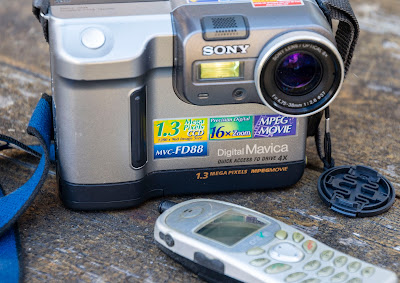
You never forget your first digicam or your first cellie, I guess...

Over the next few years I upgraded digital cameras twice, first to a Nikon Coolpix 990 in 2003, and then a Kodak EasyShare V1073 in 2008. I was still using the Kodak when I got my first smart phone in 2011, an LG Optimus V, whose 3MP camera was no threat to the supremacy of the EasyShare with its 10MP sensor and sharp Schneider-Kreuznach 3X optical zoom lens.

My next phone with a camera was a Samsung Galaxy SII and, to be perfectly honest, if I hadn't gotten back into photography as a hobby, that's where I would have stopped buying cameras. The Galaxy's camera had an 8MP sensor and turned out perfectly adequate snapshots.

Here's the thing, though: That generation of smart phones... the Galaxy SII and the iPhone 5 ...put perfectly adequate snapshot cameras into the hands of millions of people, some percentage of whom eventually wanted more. Being on Instagram or Flickr can expose a person to some pretty cool imagery of the kind that can't exactly be duplicated with a fixed 24mm lens and a 1/2.3" sensor.

Dozen-year-old cameras are still useful, unlike dozen-year-old smart phones.

Just like back in the film days, some people got their start with a Brownie or an Instamatic and decided that they liked taking pictures and wanted to be able to do more, a certain percentage of folks are using the modern-day equivalent of those ubiquitous snapshot cameras...and deciding that they want more.

Will digicam sales ever return to what they were? No, but only if you count the standalone inexpensive general purpose digicams. People don't need those anymore, because there's already one strapped to their phone.

But cameras for the specialized activity of photography are still with us, and maybe having a bit of a revival. After all, it's never been easier to share your photos than it is right now.

What about you? Have you noticed an uptick in actual cameras where you are?
.


*EDIT: My bad, my memory had failed me. The brown ’75 Granada was a coupe, not a sedan. It may have been a depressing six-cylinder crapbbox bought for two hundo as basic transportation at what was maybe the low ebb of my life to date, but I still had standards, dammit.

10.14.2007

Hidden Advantage

Marko writes about the retirement of my old Sony Mavica FD. It really is an obsolete system, with its non-standard battery pack and a resolution bettered by most cell phones these days.

The Mavica FD had one thing going for it however, the reason I bought it back in late 2001: With its photos being stored on its built-in 3.5" floppy drive, its storage may have been limited, but spare disks could be acquire anywhere. Also, what other digicam could interface, dongle-free, with any desktop computer built since the late '80s?