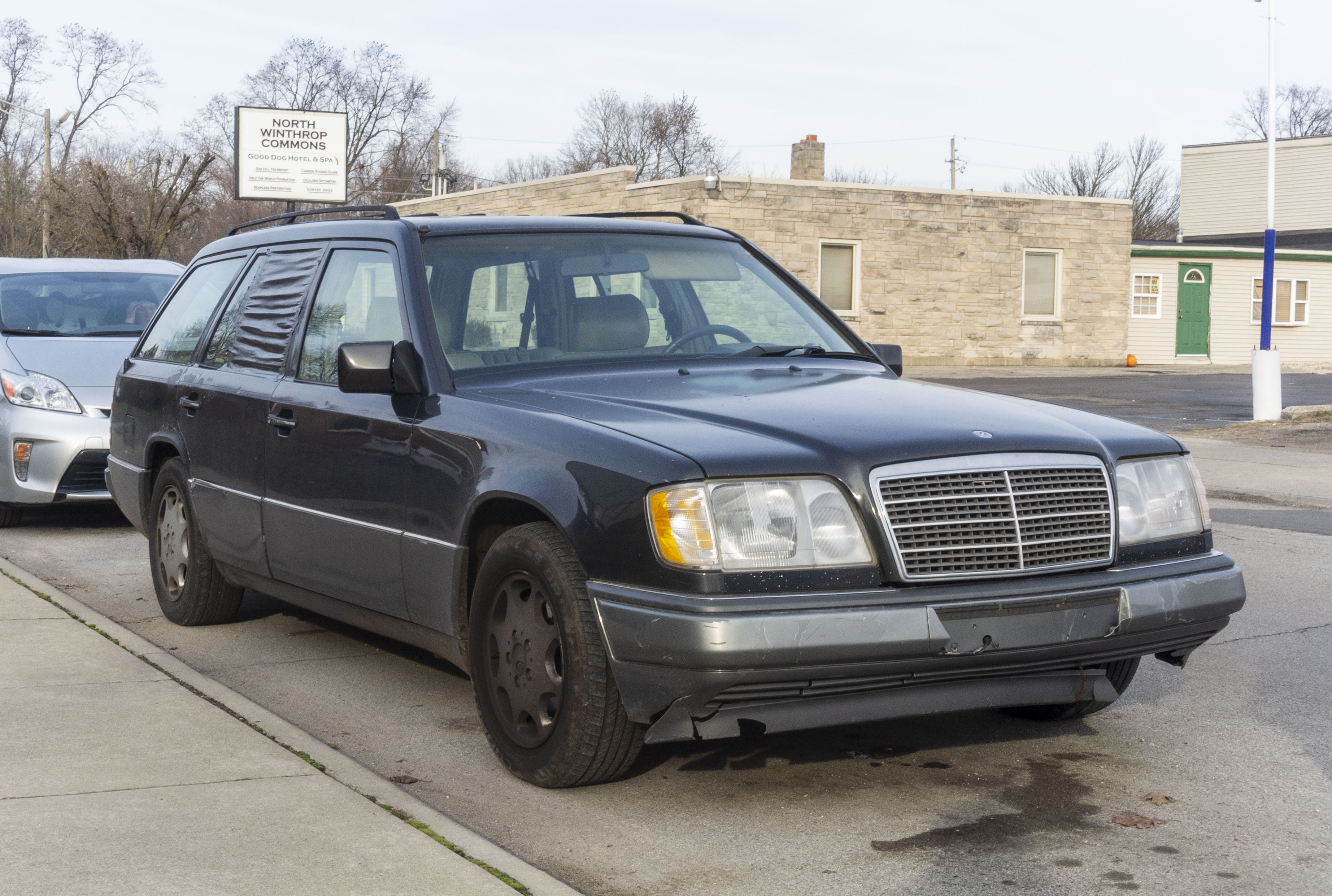
It's not likely to blossom into real fandom for me, but having put in a fair amount of time with the K20D and the K7 now, I can see why Pentax has a loyal following. They're compact, rugged, and have sensible control layouts.
Showing posts with label 2008. Show all posts
11.17.2025
8.22.2025
Down the K-hole: Pentax K20D
The K20D was Pentax's second generation of semi-pro DSLR, replacing the K10D in January of 2008.
While its $1,300 MSRP put it head to head with Canon's EOS 40D, the price leader in the category, its Samsung-sourced 14.6 megapixel CMOS sensor offered almost half again the resolution, making it the highest-resolution APS-C camera on the market at the time (tied, of course, with its Samsung-badged clone, the GX-20.)
It was Pentax's top-of-the-line DSLR, but the line in question only consisted of the K20D and the cheaper, lower-resolution K200D.
The mode dial has the usual full-auto (green rectangle) and PASM modes, along with a couple unique-to-Pentax settings. The "TAv" position is "Shutter and Aperture Priority", where the user operates the front and rear dials to manually select the shutter speed and aperture size and the camera automatically adjusts the ISO to try and get the best exposure. "Sv" is "Sensitivity Priority" and functions like Program mode except the rear dial is used to set ISO on the fly, which is useful when operating in an environment where lighting conditions might vary wildly.
It's a physically small camera in the category; noticeably smaller than the Canon, Nikon, and Olympus entries and even slightly svelter than the Sony a700.
It's missing some typical buttons, such as ISO, instead using a combination of the "Fn" button and on-screen menus to select these settings.
The battery and memory card doors are securely latched and the whole camera feels quite rugged. With its 14.6MP sensor and an ISO range from 100 to 3200 (expandable to 6400), the K20D still holds up quite well today and nice used ones can be found for well under two hundo.
Labels:
2008,
APS-C,
camera reviews,
digital photography,
DSLR,
old digicams,
Pentax
8.16.2025
DSLR Pics: Draft Animals with the Pentax K20D
Here are a couple of photos from the Pioneer Village farming exhibition at the 2025 Indiana State Fair taken with the Pentax K20D and the DA 18-135mm f/3.5-5.6ED zoom lens.
The upper photo is a straight-out-of-camera JPEG while the lower two were processed from the original PEF (Pentax's RAW format) in Adobe Photoshop.
Labels:
2008,
APS-C,
digital photography,
DSLR,
old digicams,
Pentax
8.15.2025
DSLR Pics: Porsches with the Sony a700
Both photos are straight-out-of-camera monochrome JPEGs, shot on different days using the Sony a700. The upper one, the 911 Targa 4 GTS, was snapped with the Sony 16-50mm f/2.8, while the lower 911 Turbo Cabrio used the Sony 16-80mm f/3.5-4.5 Carl Zeiss Vario-Sonnar T* zoom lens.
Labels:
2008,
APS-C,
digital photography,
DSLR,
old digicams,
Sony,
Zeiss lenses
5.18.2025
Dual slot? Maybe not!
The second on my list of "pro features" after dual control wheels was dual card slots, although in the year 2008, that was still generally found only on the top models of most lineups.
The 1D Mark III and 1Ds Mark III each had one Compact Flash and one SD card slot, but the contemporary 5D Mark II only had the CF slot. Similarly, Nikon's pro D3 had a brace of CF slots, but the D700 only had the one.
Stepping down from full frame to crop sensor, the Canon EOS 40D and Nikon D300 only had one CF slot. Likewise, the Pentax K20D, which was the top digital Pentax of the time, had a lone SD card slot for storage.
Only the Sony a700 and Olympus E-3 had a pair of card slots among the cameras in this tier, but that's for a specific reason. See, both Sony and Olympus had their own in-house memory card formats, so their DSLRs had one slot for Compact Flash and one for Sony Memory Stick (on the a700) or xD (on the E-3).
![]() |
| The card slots on an Olympus E-3 |
Unlike the dual slots on the pro Nikon and Canon cameras, you couldn't record to both of these cards at the same time, it was strictly one or the other.
It wouldn't be until later, in cameras like the Nikon D300S and D7000 that Nikon let dual card slots trickle down, and Canon users had to wait for the 5D Mark III and 7D Mark II.
5.16.2025
Dead Format Bonus
Sony discontinued their A-mount DSLRs (all basically evolved Minoltas) back in 2012, and the A-mount pellicle mirror SLT cameras not too many years after, so that leaves the A-mount an essentially dead letter.
Used prices on fairly high-spec glass are dirt cheap. That 16-50mm f/2.8 in the picture? Less than two hundo. I found a Sony DT 16-80mm F3.5-4.5 ZA Carl Zeiss Vario-Sonnar T*, which listed for nearly thousand bucks new, for barely over a Benjamin used.
Of the cameras in its class at the time (Canon EOS 40D, Nikon D300, Pentax K20D, and Olympus E-3), the Sony a700 was the only one without an LCD panel on the top plate. Interestingly, like the Pentax and Nikons, it also has a focus motor in the body, allowing it to use older autofocus lenses.
The 12MP sensor has enough resolution that you can get away with a bit of cropping, too.
| MGA snapped with the 16-80mm lens. Cropped somewhat. |
Labels:
2008,
APS-C,
digital photography,
DSLR,
Sony,
Zeiss lenses
5.11.2025
DSLR Pics: Cars with the Pentax K20D
So I had the Pentax K20D out for its inaugural outing of car-spotting, even though the DA 16-45mm f/4 lens is a little short for the task, being a rough equivalent of a 24-70mm lens on a full-frame body.
The Samsung-made 14.6 megapixel CMOS sensor gives a little leeway for cropping if necessary, so it wasn't that much of a hindrance. Pentax has an 18-135mm f/3.5-5.6 zoom that was shipped as a kit lens with some of their nicer crop sensor DSLRs and is therefore available for a song on the used market. I might pick one up for comparison purposes.
These were shot in RAW and run through a quick auto JPEG conversion in Photoshop.
5.10.2025
Retro Shootout?
Remember how I was talking about the "prosumer" grade crop sensor cameras the other day? In the 2007-2009 period, that would have meant the Nikon D300, the Canon EOS 40D, and the Olympus E-3. It also would have included the Pentax K20D, which had full weather seals and a plastic shell enclosing a rugged metal chassis.
I don't have a D300 anymore, having traded it in on a D300S, which is basically the same thing, but with dual card slots and video, but I do have a 40D and an E-3.
Hey, you know what you can get really cheap on the used market these days?
![]() |
| A Pentax K20D with a 16-45mm f/4 zoom lens |
That DA 16-45mm F4 ED AL lens came out in 2003 and was one of Pentax's first digital-specific zoom lenses and, like the camera itself is available for a song because there are newer and cooler alternatives. Altogether the whole setup was a couple hundo at Used Photo Pro.
5.02.2025
DSLR Pics: Tractors at the State Fair with the Nikon D700
These are from the 2019 Indiana State Fair, using a Nikon D700 and a basic, inexpensive 24-120mm f/3.5-5.6 VR zoom lens.
Despite dating to 2008 and having "only" a 12MP full-frame (FX, in Nikon-ese) sensor, the D700 is still an extremely viable camera. They're built like tanks and there are examples running around out there with seven-digit shutter counts.
Labels:
2008,
digital photography,
DSLR,
Nikon,
Nikon FX,
old digicams
2.03.2024
Digicam Pics: Textures with the Kodak Easyshare V1073
The interface on the Kodak Easyshare V1073 is almost entirely handled through an array of somewhat cryptic menus on the touchscreen.
There are a total of six physical controls on the entire camera. On the top plate are a power button and the shutter release. On the rear of the camera, arranged vertically along the right edge beside the 3" touchscreen, are (from top to bottom) a little up-down lever to control the lens zoom as well as magnification during playback, the "play" button for image review, a cryptically-labeled "menu" button that takes you to the low-level stuff like carf formatting and setting the date and time, and a button marked [i] that will bring up any available help menus for the current activity on the touchscreen.
Labels:
2008,
digital photography,
Kodak,
Kodak Easyshare,
old digicams
1.30.2024
Re-Shoots
I used the Amazon gift card Bobbi gave me for my birthday to order a used Kodak Easyshare V1073.
Now I have a copy of each digicam I used before getting my first DSLR:
Alas, I won't be able to re-do the Lucky Gunner Blogger Shoot, or Knob Creek, or classes with Louis Awerbuck and Todd Green, or...
Now I have a copy of each digicam I used before getting my first DSLR:
- Sony Mavica FD88
- Nikon Coolpix 990
- Kodak Easyshare V1073
- Canon PowerShot SX500
Alas, I won't be able to re-do the Lucky Gunner Blogger Shoot, or Knob Creek, or classes with Louis Awerbuck and Todd Green, or...
![]() |
| Kodak Easyshare at Knob Creek in 2011 |
Labels:
1999,
2000,
2008,
2012,
Canon,
Canon PowerShot,
Coolpix,
digital photography,
Kodak,
Kodak Easyshare,
Nikon,
old digicams,
Sony,
Sony Mavica
1.07.2024
A Tale of Two Nikons, Part Two
History is replete with examples of super-powered dynamic duos: Batman and Robin, Ruth and Gehrig, Swift and Kelce, Pinky and The Brain.
If you're a Nikon fan you could add to that list the D3 and D700.
That pair was actually a successful reboot of an iconic power couple from the closing days of the film era. Nikon's F5 was a bombshell professional grade camera that arguably established the shape and size of future pro bodies from all the serious manufacturers. It was packed to the gills with the latest technology 1996 could conjure, and it had a built-in vertical grip that both made it easier to use in portrait mode and also held the eight AA batteries that, at eight frames per second, could suck up a 36 exposure roll of Velvia in about the time it takes you to say "Whoops! I totally forgot that film costs money!"
The F5 was an enormous, heavy, incredibly rugged camera, which you could use to bludgeon someone into unconsciousness and then take perfectly-exposed, crisply-focused pictures of the crime scene.
So in 1999 they gave it a little brother in the form of the F100. Still rugged, still weather-sealed, but it lost the bulbous vertical grip and its cavernous battery compartment. This shaved three and a half frames per second off the frame rate, but it also shaved a whole pound off its bulkier sibling's avoirdupois, from 2.75 pounds to 1.73, batteries included.
The F100 was popular with photogs who worried about weight or wanted something a little more discreetly-sized than the enormous full-on pro F5, as well as making an excellent second body for the traveling professional photographer.
Fast forward to 2007 and Nikon released the D3, its first DSLR to sport a full-frame sensor, which they dubbed "FX" format in Nikon marketing-speak. Nikon's first two generations of digital pro bodies, the D1 and D2, were like the F5 in size, shape, features, and ruggedness, but housed a smaller APS-C DX sensor. Since Canon had full-frame bodies in its lineup since 2002, Nikonians had been itching for a return salvo for five long years.
The D3 was an enormous pro camera, though, with a price tag to match. So the following year's announcement of the D700, which was lighter and smaller and less expensive without sacrificing important features or essential ruggedness or... most importantly ...that big 12MP CMOS sensor, was greeted with hosannas.
Of course, what good is a smaller, lighter camera without smaller, lighter lenses?
Hey, look at this mid-'90s Mercedes-Benz E320 wagon I snapped using the Nikon D700 and 28–200 mm f/3.5-5.6G zoom lens!
The 28-200mm G is tiny and light for its focal length range, much smaller and lighter than my rugged old 24-120mm f/3.5-5.6D "Street Sweeper".
It's not without its downsides. The lightness comes from its construction, with both the barrel and mount made of plastic. You wanna remember that plastic mount if you have it mounted on a D3; with a regular metal-mount lens you can pick up even a heavy Nikon pro body by the lens, but I wouldn't do that with a 28-200G.
The small size comes from the lack of a manual aperture ring, as well as the lack of a Vibration Reduction system or an internal focusing motor. Unless your camera has an in-body focusing motor, this is a manual focus only lens. And even with autofocus it can be slow to travel from one extreme of the focusing range to the other.
But it gives great results, all things considered, and did I mention it's crazy small and light? Jim Grey reviews it here, Ken Rockwell here, and there's a fascinating piece by the gentleman who designed the lens here.
I snapped the same Mercedes wagon with the Nikon 1 J1.
It really gives you an idea for the effect of sensor size on depth of field. The little 1" sensor J1 was shooting at f/4.8, while the big full-frame D700 was shooting at f/7.1, yet there's enough background blur with the latter to really make the subject pop.
I like the Nikon 1 J1, but I love the D700.
.
Labels:
2008,
2011,
digital photography,
DSLR,
MILC,
Nikon,
Nikon 1,
Nikon CX,
Nikon FX,
old digicams
1.06.2024
A Tale of Two Nikons, Part One
I was out walkabout yesterday with a pair of Nikons.
One was sleek and modern looking, even slightly futuristic. When it came out in 2011, it was the wave of the future; compact and mirrorless with an electronic shutter and live view.
The other was big and clunky, a stylistic throwback to Nikon's pro bodies of the late Nineties. While it made a splash on its release in 2008 for being a full-frame Nikon with a number on its price tag lower than the ones usually associated with a decent used car, it was actually an atavistic throwback.
In 2008 a camera with a flappy mechanical mirror was like a late Cretaceous dinosaur; a magnificently evolved beast with no idea that there was a mirrorless asteroid only a decade away from smashing into the market.
Yet the mirrorless Nikon 1 J1 is a footnote, a failed branch on the Nikon evolutionary tree, while the D700 is a photographic Tyrannosaurus rex: extinct, but a legend.
Inside the body of the J1 is a 10MP CCD sensor by Aptina. It was a 1" sensor, a common size for luxo enthusiast compacts, but Nikon has to make up names, so it's a "CX" format sensor, to match "DX" (which everyone else calls APS-C) and the full-frame FX.
The 1" size is the biggest of the small sensors, in much the same way that Four Thirds is the smallest of the big sensors. It's physically large enough that with a large enough aperture you can actually get some background blur, and you can shoot as high as ISO 400 without horrific amounts of noise.
Hey, look at this Camaro Z28 I photographed with the J1!
The J1 was the cheaper half of a two-camera Nikon 1 ecosystem when it came out, with a more poshly-appointed V1 model above it. They used the same lenses and sensor, though.
I had the kit lens on the camera for my walk. This is a 10-30mm f/3.5-5.6 VR affair that collapses to a reasonably compact size. With this lens the J1 is pocketable, provided we're talking about the sort of roomy pockets found on coats and jackets, not the trouser sort.
Poking a button on the side of the lens barrel and giving the rubber-coated zoom ring a twist will extend the lens and power up the camera. Now you have a 27-82mm equivalent zoom lens that will focus anywhere from eight inches out to infinity (or the end of the universe, whichever comes first.)
I should point out that when I say that the J1 was the cheaper of the Nikon 1 duo, that doesn't mean it was, you know, inexpensive. The body and lens combo I was holding came as a kit for $650 back in 2011, which is the equivalent of nine hundo today. Even back then you could get a beginner DSLR kit for about that price; Nikon's own D3100 went for $699 with a kit zoom.
I also snapped the Camaro with the D700, which had a 28-200mm f/3.5-5.6 AF-G zoom lens parked in front of its twelve megapickle full-frame CMOS sensor... but we'll talk about the D700 and that swoopy little superzoom in the next post.
Labels:
2008,
2011,
camera reviews,
digital photography,
DSLR,
MILC,
Nikon,
Nikon 1,
Nikon CX,
Nikon FX,
old digicams
7.22.2023
What counts as a fossil?
Ten years is my cutoff line for "fossilization" for electronica.
With the march of time, that means that cameras like the Canon EOS 5D Mark II qualify. It was introduced at the end of 2008, just in time for Christmas shopping, and discontinued in December of 2012.
Still, though, it feels weird to call a 21MP DSLR that's capable of shooting HD video a "fossil".
Time marches on. The Sony Mavica was a wonder in its day, too.
![]() |
| Taken with an EOS 5D Mark II |
10.21.2022
Sensor Sweep
Interestingly, I happened to get photos of the same subject at the same time of day, albeit about a month apart, with two different cameras of broadly similar vintage and capabilities.
It's midafternoon, I'm sitting out front of Fat Dan's on College Avenue, and here comes that gorgeous Elm Green Volkswagen Karmann Ghia!
The first time is August 31st, and I've got the Nikon D700 wearing the compact 28-200mm f/3.5-5.6G super zoom.
The D700 came out in 2008 and packed the 12MP full-frame CMOS sensor and EXPEED processor of the previous year's pro D3 camera into a smaller body. Priced at $2999, two grand less than the D3, it lost some features, like the vertical grip and larger battery, the second card slot, and was downgraded from 9fps to 5fps, but it was still ruggedized and weather sealed.
The 28-200 lens mounted on it favors compactness and focal length range over ultimate optical performance, but it's a Nikon and still does a pretty good job.
This was shot at a focal length of 95mm in Program mode with the camera set at its base ISO of 200, and the camera went with 1/400th of a second at f/10.
About a month later, early October, I'm sitting the same place around the same time when here comes the Karmann Ghia again!
This time I had a Canon EOS-1D Mark IV with the excellent EF 24-105mm f/4L IS general purpose zoom lens mounted.
Released in 2009, the $4999 EOS-1D Mark IV was Canon's top-of-the-line pro camera aimed at sports and wildlife photographers and photojournalists. It had a 16MP APS-H sensor, slightly smaller than the full frame one the company used in its studio & landscape oriented -1Ds series. This is because it prioritized frame rate; the Mark IV could blaze away at 10fps until the buffer filled.
The 24-105/4 "L"-series lens has a field of view equivalent to a 31-137mm lens on the 1D, due to the 1.3x crop factor of the APS-H sensor.
I was shooting in Aperture Priority mode at f/5.6 to ensure reasonably fast shutter speeds at the base ISO of 100 in the late afternoon sunlight.
Both images were shot in RAW and minimally processed through Photoshop's Camera RAW convertor.
It's interesting that a decade and a half on, the prices of the cameras have decreased dramatically, but the relative price gap remains fairly consistent. Nice used D700s are running around $300-400, while a 1D4 is still going to set you back six or seven hundred bucks.
Both lenses are discontinued. The 24-105mm f/4L IS has been replaced with a "Mark II" version. The handy little 28-200mm f/3.5-5.6G, a marvel when it was released, lacks an internal focusing motor or any kind of stabilization, and is therefore not amenable to being used on mirrorless cameras or most Nikon DX DSLRs.
It's fun to use these old pro cameras I never could have afforded when they were new. They were built to last and plenty were traded in with a lot of life left in them. There are D700s running out there with a million documented shutter actuations; if you run across a used one with only a few thousand on the clock, it's barely broken in.
.
10.26.2021
Too Late to the Party
Return with me to the distant past of...oh, let's call it 2005 or so. Cell phones are everywhere, but not yet universal. While a significant percentage of high school students have their own mobile, a cell phone is still a "going off to college" thing, as often as not.
Facebook and YouTube are in their larval states. AOL Instant Messenger is still extremely popular. Various phones were integrating limited browser functions, but with mobile phones like the RAZR, texting was still the primary form of communication.
It was into this environment that Sony, a company known for being willing to try weird experiments, released a device called the "mylo COM-1"in September of 2006. The name stood for MY Life Online, and it was a little miniature tablet thingie with a slide-out keyboard. It could run a web browser and do email anywhere there was a wifi signal.
Thing is, despite being targeted largely at teens who didn't have cell phones, it had a sort of jellybean Playskool "My First Toy Handheld" look about it and cost $350 at launch. That was a lot of clams for something that looked like a kiddie toy and had a crude 2.4" 320x240 pixel display.
So less than a year and a half later, in January of 2008, Sony dropped the "mylo COM-2" on the market. The COM-2 was slicker and more adult-looking, sharing its form factor with the PlayStation Portable.
It had a tack-sharp 3" 640x480 LCD that added touchscreen functionality, and a tethered stylus was included, attached to the neoprene carrying sleeve. They keyboard was improved, and was now backlit. There were menu shortcuts for the most popular communications apps of the day...
The browser now supported Flash for playing YouTube videos and online games. There was a 1.3MP camera on the backside with a convex mirror next to the lens for taking selfies. The desktop could be configured with your most-used apps.
It had its own built-in music and video players, and a photo album. It had a feed reader and built-in games. It could transmit music and pictures to other nearby mylos.
It was really a slick little device...
Thing is, between the launch of the COM-1 and COM-2, it was almost instantly rendered obsolete by the announcement of the iPhone, which could do all of this stuff and then some. Plus, you know, you could use the Apple device to make phone calls.
The COM-2, launched in January for $299 (yes, all that added capability over the COM-1 came with a fifty dollar price cut; Sony could see the writing on the wall) and by the 2008 holiday season was being fire-saled for $199. Slow sales caused it to be quietly discontinued by the end of the following year.
Smartphones and tablets killed a lot of categories: They decimated handheld GPS's and cheap cameras and palmtop computers; they cut deeply into the sales of calculators and handheld games and MP3 players. The one thing they killed that almost nobody remembers is the "smart not-phone", since it was only around for a year or so and sank without a ripple.
.
Labels:
2008,
digital archaeology,
handheld gaming systems,
trivia
Subscribe to:
Posts (Atom)