Showing posts with label Nikon 1. Show all posts

11.08.2025

Mirrorless Pics: Local shots with a Nikon 1 V3


The Nikon 1 V3 was the ultimate iteration of the high-end V-series of the Nikon 1 compact mirrorless cameras. Released in 2014, it was a big improvement in image quality and video capabilities over the V2 and introduced a tilting rear screen to the Nikon 1 series, but had some quirks. 

Unlike the V1 and V2, it did not have a built-in EVF. You could get a detachable EVF that mounted to the hot shoe, but that precluded the use of a flash. Further, it had only a notional grip unless you purchased and attached the separate GR-N1010 grip.

With the EVF and grip attached, it was a bigger camera than the Nikon 1 V2 it replaced. Without them attached, it looks a little silly with the big 1 Nikkor 10-100mm f/4-5.6 VR PD-Zoom lens attached.


4.29.2025

Lenses I Live By: The Short Portrait

Portrait lenses tend to be longer than standard primes, since this allows taking photos without having to be all up in the subject’s grille, as well as exaggerating the effects of focal length compression to not cause the subject’s features to look distorted.

The “short” portrait focal length range, in my own personal lexicon, runs from about 75mm to 105mm, in full-frame terms. (I use “full-frame terms” because the 35mm format spent something like fifty years establishing itself as the lingua franca of normie photography jargon.) 

Most of the camera systems I use have a lens that falls into this category. For instance, the Nikon 1 system, with its little 1" CX-format sensor, has the 1 Nikkor 32mm f/1.2, which has the equivalent focal length of 87mm.

Nikon 1 V2 & 1 Nikkor 32mm f/1.2

Moving up to Micro Four Thirds, there are some pretty slick choices. Panasonic goes with 42.5mm focal lengths, which is an 85mm equivalent, in an inexpensive f/1.7 version and a bucks-up Leica Nocticron-branded f/1.2. Olympus, on the other hand, favors the 90mm equivalent 45mm focal length. They, too, offer a spendy f/1.2 PRO lens, but the M. Zuiko Digital 45mm f/1.8 is so compact, light, and inexpensive that it's the one I choose.

Things are similar with the Fujifilm X-mount ecosystem. There's a honking big 56mm f/1.2 portrait lens, but again, the bargain is the XF 50mm R WR "Fujicron", for its compact size and value pricing.

Fujifilm X-T2 & XF 50mm f/2 R WR

For my full-frame Canon DSLRs, I count on the EF 85mm f/1.8 for this task.

Canon EOS 5DS & EF 85mm f/1.8


6.20.2024

I wish...


That picture of sleepy Huck was snapped with the Nikon 1 V2 and the 1 Nikkor 32mm f/1.2 portrait lens. That was the closest thing to a professional lens Nikon made for the Nikon 1 system. Well, that and the 70-300mm telephoto zoom.

I wish they'd made some pro-type zooms to go with the V-series bodies. A 10-45mm f/4, which would be a rough 28-120mm equivalent would be a banger.

.

4.21.2024

Mirrorless Pics: Neighborhood people with the Nikon 1 V2


Out and about on an unusually chilly Saturday afternoon in mid-April with the Nikon 1 V2 wearing the 1 Nikkor 32mm f/1.2 lens.


3.23.2024

Mirrorless Pics: Neighborhood people with the Nikon 1 V2


I had the Nikon 1 V2 and the 1 Nikkor 32mm f/1.2 portrait lens with me yesterday. Even though I set an upper ISO limit of 800, the tiny 2012-vintage 14MP Aptina-made 1" sensor does get noisy.

Despite lacking VR stabilization, the whopping f/1.2 aperture on the 32mm lens allows usable speeds in reasonable indoor lighting.


2.11.2024

Mirrorless Pics: Neighborhood people with the Nikon 1 V2


I know I go on at length about it, but the 1 Nikkor 32mm f/1.2 is just such a wonderful portrait lens. It's got a large enough aperture that you don't need to crank the ISO through the roof, which makes the little 1" CX-format sensor get noisy in a hurry. The aperture is also large enough that you get some actual subject separation and the bokeh is pleasant to boot.


1.08.2024

Feeling the Wantsies

Feeling the urge for a 70-300mm f/4.5-5.6 VR zoom for my Nikon 1 cameras. Thing is, I would only buy one from a seller with a known rep for testing their used gear and an unconditional return policy (for me this means KEH or Roberts/Used Photo Pro.)

They'll turn up at both those sellers in the $300-$500 range reasonably frequently, but sell fast, and so far I've failed to strike when the iron was hot.

Lenses for the Nikon 1 system tend to have fragile diaphragms and as a bonus, the super telephoto 70-300 has a ribbon cable that will eventually fail with enough extensions and retractions between the collapsed "storage/travel" position and the extended "in use" position (most folks who happily use them seem to just keep them extended all the time and turn the camera on and off with the body switch). Since the whole Nikon 1 series is long discontinued, when the ribbon cable fails, the lens is bricked.

But the allure of a sharp, bright 189-210mm equivalent zoom lens is powerful.

It seems that having compact super telephotos is one of the big appeals of small sensor photography, and I'm surprised Nikon didn't go after that harder early in the Nikon 1 system's lifespan.

1.07.2024

A Tale of Two Nikons, Part Two

History is replete with examples of super-powered dynamic duos: Batman and Robin, Ruth and Gehrig, Swift and Kelce, Pinky and The Brain.

If you're a Nikon fan you could add to that list the D3 and D700.

That pair was actually a successful reboot of an iconic power couple from the closing days of the film era. Nikon's F5 was a bombshell professional grade camera that arguably established the shape and size of future pro bodies from all the serious manufacturers. It was packed to the gills with the latest technology 1996 could conjure, and it had a built-in vertical grip that both made it easier to use in portrait mode and also held the eight AA batteries that, at eight frames per second, could suck up a 36 exposure roll of Velvia in about the time it takes you to say "Whoops! I totally forgot that film costs money!"

The F5 was an enormous, heavy, incredibly rugged camera, which you could use to bludgeon someone into unconsciousness and then take perfectly-exposed, crisply-focused pictures of the crime scene.

So in 1999 they gave it a little brother in the form of the F100. Still rugged, still weather-sealed, but it lost the bulbous vertical grip and its cavernous battery compartment. This shaved three and a half frames per second off the frame rate, but it also shaved a whole pound off its bulkier sibling's avoirdupois, from 2.75 pounds to 1.73, batteries included.

The F100 was popular with photogs who worried about weight or wanted something a little more discreetly-sized than the enormous full-on pro F5, as well as making an excellent second body for the traveling professional photographer.

Fast forward to 2007 and Nikon released the D3, its first DSLR to sport a full-frame sensor, which they dubbed "FX" format in Nikon marketing-speak. Nikon's first two generations of digital pro bodies, the D1 and D2, were like the F5 in size, shape, features, and ruggedness, but housed a smaller APS-C DX sensor. Since Canon had full-frame bodies in its lineup since 2002, Nikonians had been itching for a return salvo for five long years.

The D3 was an enormous pro camera, though, with a price tag to match. So the following year's announcement of the D700, which was lighter and smaller and less expensive without sacrificing important features or essential ruggedness or... most importantly ...that big 12MP CMOS sensor, was greeted with hosannas.

Of course, what good is a smaller, lighter camera without smaller, lighter lenses?

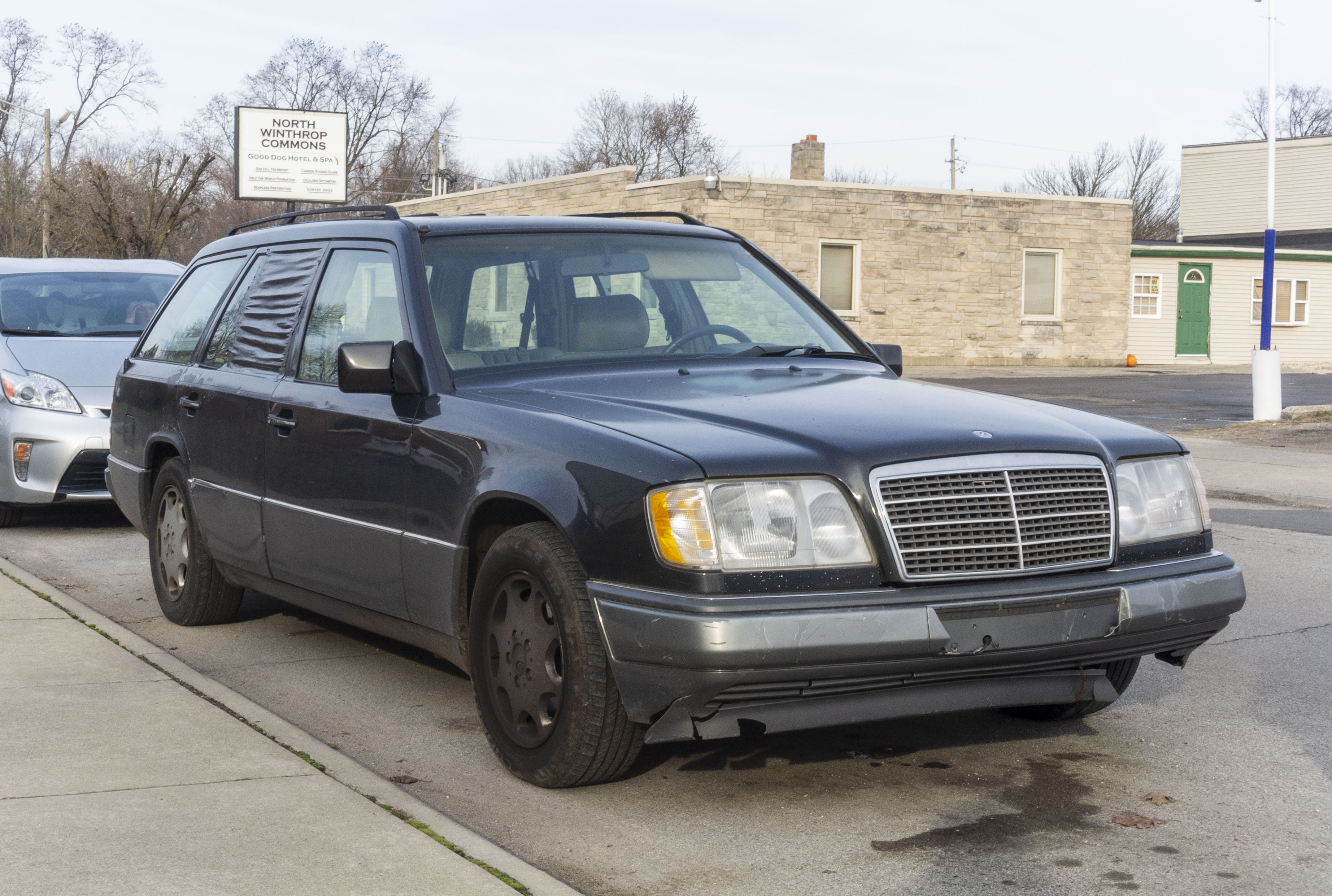
Hey, look at this mid-'90s Mercedes-Benz E320 wagon I snapped using the Nikon D700 and 28–200 mm f/3.5-5.6G zoom lens!


The 28-200mm G is tiny and light for its focal length range, much smaller and lighter than my rugged old 24-120mm f/3.5-5.6D "Street Sweeper".

It's not without its downsides. The lightness comes from its construction, with both the barrel and mount made of plastic. You wanna remember that plastic mount if you have it mounted on a D3; with a regular metal-mount lens you can pick up even a heavy Nikon pro body by the lens, but I wouldn't do that with a 28-200G.

The small size comes from the lack of a manual aperture ring, as well as the lack of a Vibration Reduction system or an internal focusing motor. Unless your camera has an in-body focusing motor, this is a manual focus only lens. And even with autofocus it can be slow to travel from one extreme of the focusing range to the other.

But it gives great results, all things considered, and did I mention it's crazy small and light? Jim Grey reviews it here, Ken Rockwell here, and there's a fascinating piece by the gentleman who designed the lens here

I snapped the same Mercedes wagon with the Nikon 1 J1.


It really gives you an idea for the effect of sensor size on depth of field. The little 1" sensor J1 was shooting at f/4.8, while the big full-frame D700 was shooting at f/7.1, yet there's enough background blur with the latter to really make the subject pop.

I like the Nikon 1 J1, but I love the D700.

1.06.2024

A Tale of Two Nikons, Part One

I was out walkabout yesterday with a pair of Nikons.

One was sleek and modern looking, even slightly futuristic. When it came out in 2011, it was the wave of the future; compact and mirrorless with an electronic shutter and live view. 

The other was big and clunky, a stylistic throwback to Nikon's pro bodies of the late Nineties. While it made a splash on its release in 2008 for being a full-frame Nikon with a number on its price tag lower than the ones usually associated with a decent used car, it was actually an atavistic throwback.  

In 2008 a camera with a flappy mechanical mirror was like a late Cretaceous dinosaur; a magnificently evolved beast with no idea that there was a mirrorless asteroid only a decade away from smashing into the market.

Yet the mirrorless Nikon 1 J1 is a footnote, a failed branch on the Nikon evolutionary tree, while the D700 is a photographic Tyrannosaurus rex: extinct, but a legend.

Inside the body of the J1 is a 10MP CCD sensor by Aptina. It was a 1" sensor, a common size for luxo enthusiast compacts, but Nikon has to make up names, so it's a "CX" format sensor, to match "DX" (which everyone else calls APS-C) and the full-frame FX.

The 1" size is the biggest of the small sensors, in much the same way that Four Thirds is the smallest of the big sensors. It's physically large enough that with a large enough aperture you can actually get some background blur, and you can shoot as high as ISO 400 without horrific amounts of noise.

Hey, look at this Camaro Z28 I photographed with the J1!


The J1 was the cheaper half of a two-camera Nikon 1 ecosystem when it came out, with a more poshly-appointed V1 model above it. They used the same lenses and sensor, though.  

I had the kit lens on the camera for my walk. This is a 10-30mm f/3.5-5.6 VR affair that collapses to a reasonably compact size. With this lens the J1 is pocketable, provided we're talking about the sort of roomy pockets found on coats and jackets, not the trouser sort.

Poking a button on the side of the lens barrel and giving the rubber-coated zoom ring a twist will extend the lens and power up the camera. Now you have a 27-82mm equivalent zoom lens that will focus anywhere from eight inches out to infinity (or the end of the universe, whichever comes first.)

I should point out that when I say that the J1 was the cheaper of the Nikon 1 duo, that doesn't mean it was, you know, inexpensive. The body and lens combo I was holding came as a kit for $650 back in 2011, which is the equivalent of nine hundo today. Even back then you could get a beginner DSLR kit for about that price; Nikon's own D3100 went for $699 with a kit zoom.

I also snapped the Camaro with the D700, which had a 28-200mm f/3.5-5.6 AF-G zoom lens parked in front of its twelve megapickle full-frame CMOS sensor... but we'll talk about the D700 and that swoopy little superzoom in the next post.


1.04.2024

Mirrorless Pics: Ruby the dog with the Nikon 1 V2


Visiting family in Missouri for New Year's Eve, I got my cousin's pupper Ruby to sit for a portrait session with the Nikon 1 V2 & the 1 Nikkor 32mm f/1.2 lens.

I dearly love that glass.


11.25.2023

Nikon 1 V1 and the 1 Nikkor 18.5mm f/1.8


On the little 1" sensor (or, as Nikon called it, "CX format") of the V1, the 1 Nikkor 18.5mm f/1.8 is the equivalent of the Nifty Fifty. 

The f/1.8 aperture is nice and bright, but while the aperture doesn't scale in terms of brightness, it does in regard to depth of field. When it comes to blowing out the background, even wide open the maximum aperture is equivalent to f/4.86 on a full frame camera.

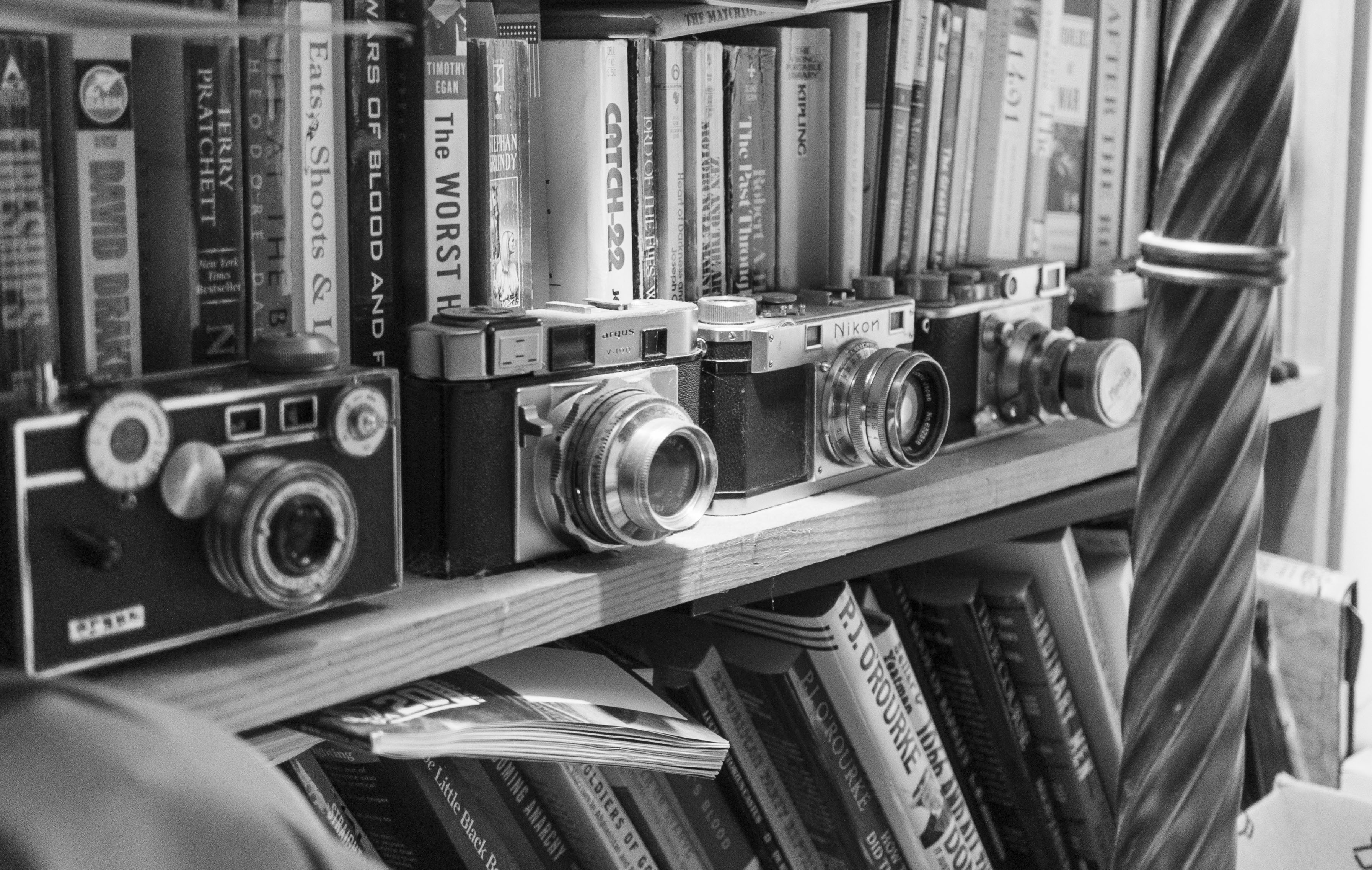
That's not necessarily a bad thing, though! Check out this wide open shot of some cameras on a bookshelf. On a full-frame body it would have had a depth of field about as thick as a sheet of paper, whereas here all the titles are legible.


11.11.2023

Mirrorless Pics: Portraits with the 1 Nikkor 32mm f/1.2

Easily the best lens in the entire lineup for the CX-format Nikon 1 mirrorless system, the 1 Nikkor 32mm f/1.2 is the equivalent of an 85mm lens on a full frame camera.

Despite the tiny 1" sensor, the f/1.2 maximum aperture can even manage a bit of background separation.


85mm is a classic focal length for portraiture and when you shrink it down to match the Nikon 1 format and put it on a little camera like a 1 V1 or V2, it doesn't feel as intimidating for subjects as would getting up in their grille with a big full-frame 85mm f/1.4.


11.06.2023

Mirrorless Pics: Lotus Evora GT with the Nikon 1 J4


Two shots of a Lotus Evora GT with the Nikon 1 J4 & 1 Nikkor 10mm f/2.8 lens.


11.04.2023

Mirrorless Pics: Indiana World War Memorial with the Nikon 1 J4

One of the best things about the Nikon 1 J4 is it lets me use the word "antepenultimate" in a sentence, because after its launch in January of 2014, Nikon only released the Nikon 1 AW1 and the 1 J5 before discontinuing the entire Nikon 1 line of cameras. Their first attempt at a mirrorless system had been a marketplace failure.

"Antepenultimate" happens to be my third favorite word. Anyway...

On a visit to the Indianapolis World War Memorial the other day, I mounted the little 1 Nikkor 10mm f/2.8 lens on the 1 J4 and tucked it into the space in my Lowepro Event Messenger 100 bag that normally holds the long 30-110mm zoom lens.

On the 1" Nikon CX-format sensor, the 10mm lens offers the same field of view as a 28mm lens on a full-frame camera. Wide angle, to be sure, but not crazy wide. I can always use the practice with a wide angle lens, because I don't really "see" images at fields of view much wider than the one offered by a 40 or 50mm lens.


I keep the Nikon 1 cameras set up to save each image as both a high-res monochrome JPEG and also as a RAW file. The photo of the World War Memorial above is an unedited JPEG straight out of the camera.

The photo below is lightly cropped. It shows off the level of detail that can be delivered by the 18MP 1" sensor, especially at its base ISO of 160.


After exploring the inside and outside of the Memorial, we ventured a block south to University Park.


It was a gorgeous day for early November in Indy. Nearly sixty degrees by lunchtime with a bit of a breeze and hardly a cloud in the sky.


I still don't really have that eye for wide angle lenses I'd like, but I'm getting a better feel for them.

.

10.30.2023

I guess it's back on?

I'd lamented before that my plan to do some extensive work with Nikon's 1 system of CX-format mirrorless cameras had hit a snag and I was calling it off.

Finding a working 32mm f/1.2 at Roberts (UsedPhotoPro), however, has me fired up to try again. I even have a brace of adorable miniature Speedlights!