7.06.2024

Mirrorless Pics: Motorcycles with the Olympus E-M1X...


Of all my cameras, the Olympus E-M1X is easily the least fossil-y. It was announced in January of 2019, meaning it's barely over five years old; a spring chicken among the stringy old hens and roosters in my camera coop. They're still available new-in-the-box, although used copies are only about a third the price.

Still, although it was announced in 2019, it uses the same Sony-manufactured 20MP LiveMOS Four Thirds sensor first introduced in the 2016-vintage OM-D E-M1 Mark II, albeit backed up with dual TruePic VIII image processors, which gets it close to at least honorary fossil status.


6.20.2024

I wish...


That picture of sleepy Huck was snapped with the Nikon 1 V2 and the 1 Nikkor 32mm f/1.2 portrait lens. That was the closest thing to a professional lens Nikon made for the Nikon 1 system. Well, that and the 70-300mm telephoto zoom.

I wish they'd made some pro-type zooms to go with the V-series bodies. A 10-45mm f/4, which would be a rough 28-120mm equivalent would be a banger.

.

6.18.2024

Small is Beautiful


An all-in-one "walking around" zoom lens is what's normally on my cameras. I like them because they're more versatile than a fixed focal length lens and have more reach than the typical 24-70mm pro zoom. They don't have as much reach as a superzoom. In non camera nerd speak, these are "5X" rather than "10X" zooms. 

The lack of focal length, however, is made up for by much better optics as well as larger available apertures over the most of the range of the lens. For instance, my favorite Nikon full-frame superzoom, the 28-200mm f/3.5-5.6, has a maximum aperture of f/3.5 at 28mm, while the 24-120mm f/4 VR is a third of a stop slower. But by the time you've zoomed out to 50mm, the 28-200 can only manage f/4.5, while the 24-120 will hold f/4 all the way out to 120mm.

The bigger hole lets in more light, allowing you to use lower ISOs or faster shutter speeds indoors or in the shade.

These lenses tend to be compact, but still fairly chonky, and that's one reason that smaller sensor cameras still appeal to me.

Thanks to the magic of crop factor, these are the equivalent lenses for full-frame, APS-C, and Micro 4/3rds:
That Micro 4/3rds lens on the Olympus, seen in the photo above, is almost an inch shorter, about a half inch smaller in diameter, and less than half the weight of the full-frame Nikon, yet it covers the same effective field of view and is a full stop brighter on the wide end, to boot. 

That's just shy of a pound's weight difference between the Nikon and Panasonic glass, and you notice that when it's hanging around your neck during a long day.


.

5.25.2024

Mirrorless Pics: Neighborhood people with the Fuji X-T2


Here are a couple more shots from the Fujifilm X-T2 and the XF 50mm f/2 R WR "Fujicron" short telephoto.


5.07.2024

Mirrorless Pics: Neighborhood people with the Fuji X-E1


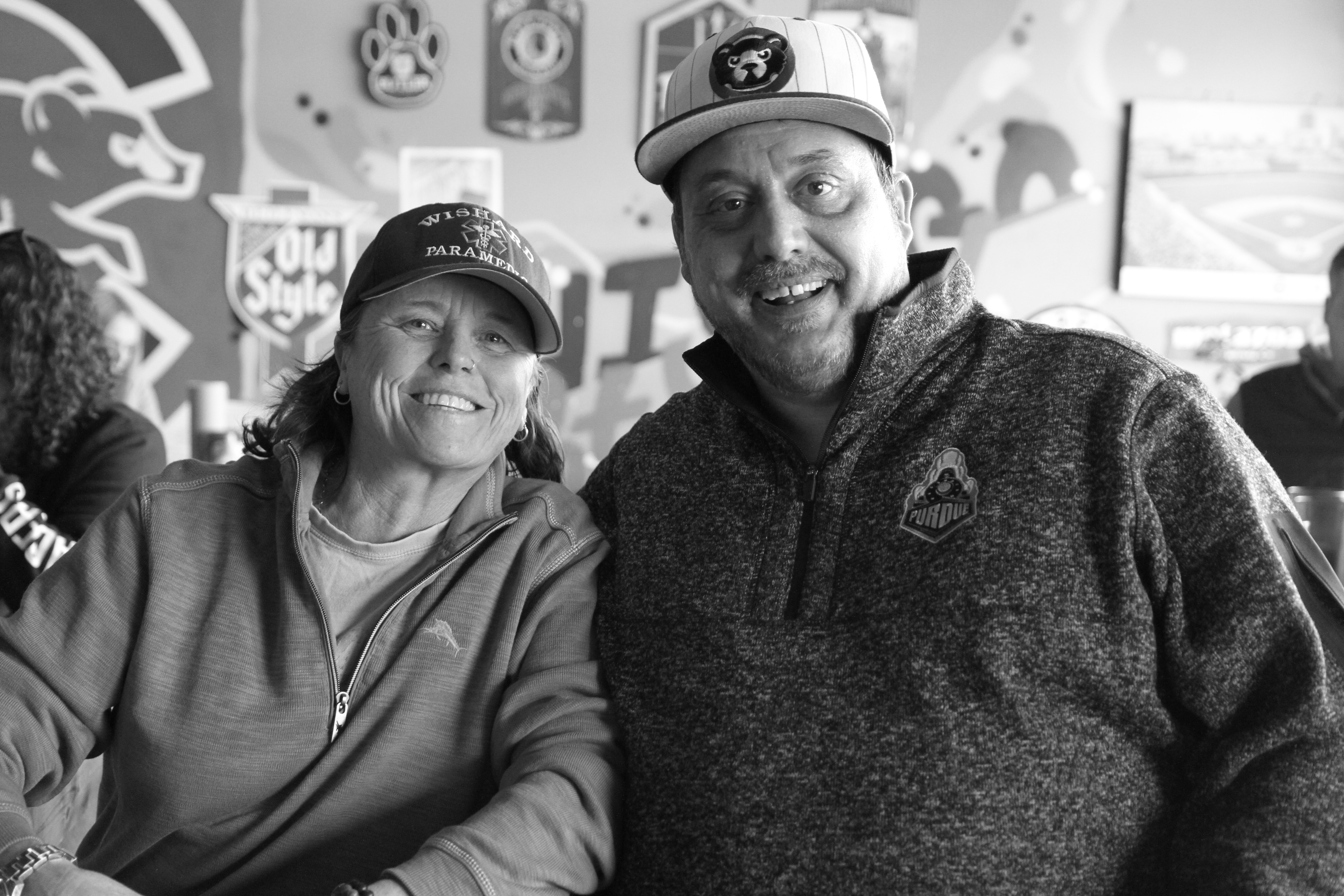
Some shots of the crew at Fat Dan's Chicago-Style Deli at 54th & College, using the Fujifilm X-E1 and the lovely little Zeiss Touit 32mm f/1.8 lens.

Being a roughly 50mm equivalent focal length, it's about as short of a lens as I'll ever use for portraiture, and its fast maximum aperture is good for making the subject stand out against a softly-blurred background. At the same time, f/1.8 and an APS-C size sensor is less likely to wind you up in those "Oops, I only had enough depth of field to get one eye in focus" situations than, say, f/1.4 on a full-frame.


5.06.2024

Two Slots, Two Shots

So, when I have a camera capable of shooting in RAW format, I’ll set it up so that it records both a RAW file and a high-res monochrome JPEG with each shot.

I have the JPEG set to monochrome because that way it displays in B&W in the image review on the rear screen after each shot, and that helps me with the whole “light and shadow and shape and texture” part of photography. I mean, I can see the colors with my own eyes without even needing the camera.

I used to do the thing where I’d save the smaller JPEG on the slower slot in the camera (the SD slot, if the camera had both SD and Compact Flash slots), but now? Now I save JPEG+RAW to both slots, because I’m more worried about a card going toes-up than I am about ensuring maximum burst rate or whatever.

.

4.21.2024

Mirrorless Pics: Neighborhood people with the Nikon 1 V2


Out and about on an unusually chilly Saturday afternoon in mid-April with the Nikon 1 V2 wearing the 1 Nikkor 32mm f/1.2 lens.


4.20.2024

Fuji XF portrait lenses...

I really enjoy candid... well, technically I guess "casual" would be a more accurate term ...portrait photography. I'm usually relatively close to the subject, so anything in the 85mm to 135mm focal length (in full-frame terms) range generally works for what I'm doing. Probably a fast 85mm would be my favorite axe.

I would love to get a dedicated portrait lens for my Fujifilm XF cameras. I'm in more or less constant danger of winding up with their 56mm f/1.2 or 90mm f/2 if I find a deal on a used one.

The only thing that's saved me so far is that I got a smokin' deal at Roberts on a used XF 50mm f/2 R WR. While the 75mm equivalent focal length is a little shorter than I find ideal, it's compact, fast, and sharp as a tack. It sure spends a lot of time on my X-T2.


4.19.2024

Blast from the past...

An ad from a 1999 issue of FamilyPC magazine for the new Sony Mavica digital camera!


3.23.2024

Mirrorless Pics: Neighborhood people with the Nikon 1 V2


I had the Nikon 1 V2 and the 1 Nikkor 32mm f/1.2 portrait lens with me yesterday. Even though I set an upper ISO limit of 800, the tiny 2012-vintage 14MP Aptina-made 1" sensor does get noisy.

Despite lacking VR stabilization, the whopping f/1.2 aperture on the 32mm lens allows usable speeds in reasonable indoor lighting.


3.20.2024

Mirrorless Pics: Neighborhood people with the Fuji X-E1


These are straight-out-of-camera JPEGs from the Fujifilm X-E1 and the wonderful Zeiss Touit 32mm f/1.8. This is one of my favorite combos, pairing a compact rangefinder-style body with a nice, fast standard prime.


3.17.2024

DSLR Pics: 1952 Chevy truck with the Canon EOS-1D Mark III


This photo was shot with the handy EF 24-105mm f/4L IS general purpose zoom lens mounted on the Canon EOS-1D Mark III.

It was shot in RAW and processed through Adobe Photoshop's RAW converter using the "B&W with red filter" setting.

Like I usually do, I have the 1D Mk3 set up to record both a RAW file and a high res monochrome JPEG. Even though I (almost) never use the straight-out-of-camera JPEG, this ensures that the image shown on the back of the camera is in monochrome and helps me keep my head in that B&W mode, looking for light, shadow, and texture rather than colors.

.

3.12.2024

DSLR Pics: Holden with the Canon EOS-1D Mark IV


It was a gorgeous day on Sunday, sunny but cool, and I figured it would be a primo day to get some squirrel photos on the way to and from lunch.

So I grabbed the EOS-1D Mark IV and EF 70-200mm f/4L IS combo, which is pretty much my favorite squirrel-spotting rig. On the way out the door I noticed Holden lounging in his perch atop the cat tree in the living room, which puts him at roughly eye-level. The bright March sunlight filtering through the drapes made the shot irresistible, so I put the camera in Aperture priority mode, opened the lens wide, bumped the ISO to 3200 and (with help from Bobbi to get the lad to look around some) started snapping.

The bottom photo is processed from the RAW and the top is a SOOC monochrome JPEG. 


On the way to lunch I didn't see many squirrels. I guess when you're arboreal you don't venture out of your drey much when the branches are waving in a 10-15mph breeze.

I did, however, see this Eastern cottontail doe...


3.11.2024

Mirrorless Pics: Neighborhood people with the Fuji X-T2


The Fujifilm X-T2 is the least fossil-y camera I have. Despite being three generations old (Fuji's up to the X-T5 now) its release date in 2016 makes it the newest interchangeable lens camera I own.

As a result, the low-light performance is mind-boggling to me. If I'm shooting indoor candids by available light, I'll open the lens aperture wide and let the camera pick the ISO and shutter speed.

These photos were both shot with the Fujinon XF 50mm f/2 R WR lens cranked all the way open. The camera selected ISO 2000 for the upper pic and a whopping ISO 12800 for the lower.

The sharpness achieved at a five-digit ISO seems amazing, considering that a decade earlier anything over ISO 400 was an unusably noisy mess.


I really like the 50mm "Fujicron". It's so compact but offers a good focal length and fast aperture for indoor candids.

.

3.01.2024

High ISO

Canon EOS-1D MkIII & 24-105mm f/4L IS, ISO 3200

While the Nikon D1X could go up to ISO 800 and the Canon EOS-1Ds Mark II went all the way to 1600, I was leery of using either one at more than ISO 400 for fear of unusable amounts of noise.

It wasn't until 2007, with the release of the Canon EOS-1D Mark III and the Nikon D3 that 1600 and 3200 became practical settings, at least in my opinion.

This seems impossibly quaint here in 2024, when I'm seeing friends posting images from Canon R6's and Nikon Z7 II's at five-digit ISOs with no really noticeable noise, but it was a big deal back then.

Nikon D3 & 24-120mm f/4G VR, ISO 1600


2.29.2024

Canon EOS-1D Mk III: The Need for Speed

One of the problems with early DSLRs, especially when shooting in RAW, was the time it took to record image files to the storage device.

Back in 2001, the Nikon high-res D1X pro body would shoot at 3 frames per second, but it filled the buffer with only six RAW (or NEF, in Nikon-speak) frames. A couple years later, the consumer-grade Canon EOS Digital Rebel could nearly equal that frame rate at 2.5 FPS, although it filled its buffer in only four shots and then required a full "five Mississippi" count until the buffer was cleared.

The big revolutionary breakthrough was the Canon EOS-1D Mark III. Released in 2007, it came with a pair of Canon's DIGIC III image processing chips (as opposed to the lone chip found on lesser Canons) and these worked in parallel to allow not only a blistering 10 frames per second max speed, but it took a full thirty RAW files before the buffer finally tapped out and needed time to catch up. If you just wanted to shoot JPEGs, you could hold the shutter button down for a full eleven seconds before the buffer needed a breather. This was a 20% increase in frame rate and a 50% increase in buffer capacity relative to the 1D Mark II it replaced.

The sound of a mirror and shutter working at ten frames a second is noticeable. It was pushing the limits for the DSLR at the time and wasn't appreciably surpassed until the 14FPS EOS-1D X of 2011.


2.24.2024

The Wrong Lens

I almost threw the big 80-400mm f/4.5-5.6D VR lens on the Nikon D3 when I headed out the door for lunch yesterday, but opted to stick with the old 80-200mm f/2.8D push-pull zoom instead.

The latter doesn't have as much reach, but it's lighter and less bulky, and the fast aperture makes it a pretty fair jackleg portrait lens.

So of course I no sooner round the corner at the end of the block than I encounter three squirrels chasing each other all over a tall-ass oak tree.


A 200mm lens on a full-frame camera is long, but not wildlife-photography-long. On top of that, the 12MP sensor of the old D3 doesn't give a ton of leeway for saving a marginal shot by cropping the bejeezus out of it.

.

2.21.2024

DSLR Pics: Neighborhood people with the Canon EOS 7D


The EOS 7D was something new for Canon. When it was released in 2009, it didn't replace the then-current EOS 50D, but rather it slid into an entirely new niche above it.

Up to that point, the two-digit EOS bodies had occupied an unusual spot in Canon's marketing strategy. Because of the high cost of the pro-oriented 5D and 1D bodies, the two-digit line had to serve two audiences: Enthusiasts who wanted a feature-laden camera, as well as pros on a tight budget.

So they were rugged metal-bodied cameras, fairly weather resistant, but also had the various "Basic Zone" modes like Sports, Portrait, Landscape, et cetera, that are beloved by more casual users.


When the 7D appeared, it was essentially a pro-grade 5D Mark II body, but with an 18MP APS-C sensor in place of the 21MP full frame unit. Gone were the Basic Mode settings, replaced by a battery of user-programmable presets.

Over time, the two-digit line lost its metal body and weather-sealing while the 7D and later 7D Mark II carried the torch as crop-sensor pro bodies, popular with airshow and wildlife photographers for their frame rate and the effective 1.6X focal length bump they gave Canon's big telephotos.

The pictures above were shot with an EOS 7D and Canon's excellent EF-S 17-55mm f/2.8 IS USM zoom lens, which is an "L" lens in all but name. They're straight-out-of-camera monochrome JPEGs.

The 7D remained in the catalog nearly five years before being superseded by the Mark II version and used ones today can be found for well under two hundred dollars, which is an incredible amount of bang for the buck.

.

2.17.2024

DSLR Pics: Neighborhood people with the Canon EOS-1D Mark III


The main reason I walk around with the EF 70-200mm f/4L IS on my EOS-1D Mark III is that, with an effective focal length bump to 260mm from the APS-H sensor, it's a decent lens for neighborhood squirrels and birds.

It wasn't until recently that I thought "Y'know, if the 24-105/4L IS can be pressed into service as an improvised portrait lens, why not the 70-200/4L IS? They have the same maximum aperture and they're both stabilized..."

So when I walked into Fat Dan's for lunch the other day, I bumped the ISO on the 1D3 up to 1600 and asked some folks if I could take their portraits.


I think it worked out okay, actually. There's a little bit of noise at ISO 1600 from the old 10MP sensor, but when you're shooting monochrome, that's no biggie.


2.16.2024

Digicam Pics: Neighborhood people with the Samsung TL500


The bartender at Fat Dan's Chicago Style Deli, photographed with the Samsung TL500. I was shooting in Program mode with the ISO set to Auto, and the camera picked ISO 200 and 1/30th at f/2.3, thereby illustrating the advantages of the lovely, fast Schneider-Kreuznach glass (most pocket cameras will only open up to f/2.8 or so at their widest; the TL500 will go all the way to f/1.8 if necessary) and Samsung's optical image stabilization.

His shirt touts Rocky Ripple, an eclectic little urban village nearby. Nestled behind levees on a floodplain island between the White River and the canal, Rocky Ripple is only accessible by two road bridges over the canal and its denizens often sport bumper stickers on their cars that read "I'm not lost, I live here."

.