Showing posts with label Fuji. Show all posts

2.06.2026

Mirrorless Pics: Neighborhood people with the Fujifilm X-T2


The Fujifilm X-T2, despite being only a few months shy of a decade old, has a modern enough sensor that you don't need a screamingly fast aperture for it to be usable doing available light portraiture indoors.

The XF 16-80mm f/4 R WR OIS is plenty fast enough and has a big enough aperture to give some degree of subject-background separation.


9.16.2025

Soulless?


I’m not really a huge fan of any one camera brand, nor am I really a hater of any. I’ve used and enjoyed all kinds of cameras, made by numerous manufacturers.

I will say that the only one that I’ve felt any antipathy toward is Sony. Don’t get me wrong, they make fine photographic appliances, but so many of them feel like just that: an electronic appliance for making photos. The only Sonys I’ve really bonded with in any way so far are the a700 DSLR, which hardly counts since Minolta did most of the heavy lifting on that one and Sony basically showed up in time to slap their name on it, and the wonderful little RX100 pocket camera.

Other than that, I’ve used Mavicas and CyberShots, NEX mirrorless bodies, as well as using an a7 and an a7 II as my work cameras for most of a year, and just never really warmed to any of them. Their menus and interfaces always feel like they were designed by someone who transferred over from the clock radio or stereo division last week.

I mean, Canons and Panasonics are pretty soulless, too, but not in that way.

You know who knows how to really nail that camera vibe? Fujifilm. They’re probably the best at it these days. Olympus and Pentax, too. They’ve got the whole camera vibe thing figured out. When you’re using one of their camera, you know that there were serious camera nerds involved in the design of the thing.

Of the big two classic Japanese camera makers, Nikon does it way better than Canon, but their attempts at retro ring hollow when compared to Fuji’s.

4.29.2025

Lenses I Live By: The Short Portrait

Portrait lenses tend to be longer than standard primes, since this allows taking photos without having to be all up in the subject’s grille, as well as exaggerating the effects of focal length compression to not cause the subject’s features to look distorted.

The “short” portrait focal length range, in my own personal lexicon, runs from about 75mm to 105mm, in full-frame terms. (I use “full-frame terms” because the 35mm format spent something like fifty years establishing itself as the lingua franca of normie photography jargon.) 

Most of the camera systems I use have a lens that falls into this category. For instance, the Nikon 1 system, with its little 1" CX-format sensor, has the 1 Nikkor 32mm f/1.2, which has the equivalent focal length of 87mm.

Nikon 1 V2 & 1 Nikkor 32mm f/1.2

Moving up to Micro Four Thirds, there are some pretty slick choices. Panasonic goes with 42.5mm focal lengths, which is an 85mm equivalent, in an inexpensive f/1.7 version and a bucks-up Leica Nocticron-branded f/1.2. Olympus, on the other hand, favors the 90mm equivalent 45mm focal length. They, too, offer a spendy f/1.2 PRO lens, but the M. Zuiko Digital 45mm f/1.8 is so compact, light, and inexpensive that it's the one I choose.

Things are similar with the Fujifilm X-mount ecosystem. There's a honking big 56mm f/1.2 portrait lens, but again, the bargain is the XF 50mm R WR "Fujicron", for its compact size and value pricing.

Fujifilm X-T2 & XF 50mm f/2 R WR

For my full-frame Canon DSLRs, I count on the EF 85mm f/1.8 for this task.

Canon EOS 5DS & EF 85mm f/1.8


4.18.2025

First pics with the Leica Digilux Zoom...

So, I've got a Fuji-branded 32MB SmartMedia card in the Digilux Zoom. With image quality set to "Fine", which is 1280x1024 pixels, that gives me 46 images worth of capacity.

While that resolution is comically low by today's standards (your typical 24MP camera is more like 6000x4000), remember that in 1999 most folks were still looking at images on 1024x768 pixel CRT monitors and those photos were being transmitted via dialup modems as often as not. A 760k image file was big.

I have white balance set to auto. 


The Leica's ISO is fixed at the native 125; even in Manual mode you can't change it. Indoors shots obviously require flash.


The screen washes out in sunlight. Fortunately it also has a tunnel-type optic viewfinder.


4.16.2025

Badge Engineering


Leica's first attempt at entering the consumer digital market happened in 1998 with the Digilux, a 1.5MP camera that was a re-badged Fuji.

In late 1999 it was replaced with the Digilux Zoom, a similarly reskinned Fujifilm MX-1700 (also known as the Fujifilm FinePix 1700 in the U.S. market.)

The Digilux Zoom boasted a Fujinon 6.6-19.8mm f/3.2-5.0 zoom lens, which combined with the crop factor of the 1/2.3" CCD sensor to give an equivalent focal length range of 38-114mm on a 35mm camera, which is a useful all-in-one zoom length.


While the body was a solid-feeling construct of aluminum and magnesium, the control layout was haphazard and the opposite of ergonomic. 

The camera used SmartMedia cards to store images and had no USB ports, so you'll need a SmartMedia-compatible card reader if you want to download images.

I'll play with this thing a bit and write an actual review.

11.04.2024

Lenses I Live By: 50mm

The basic building block of any lens kit is, or at least used to be, the fast normal prime. In full frame terms, that's generally a 50mm lens with a maximum aperture of f/1.8 or faster. I have something like this for just about every system I use.


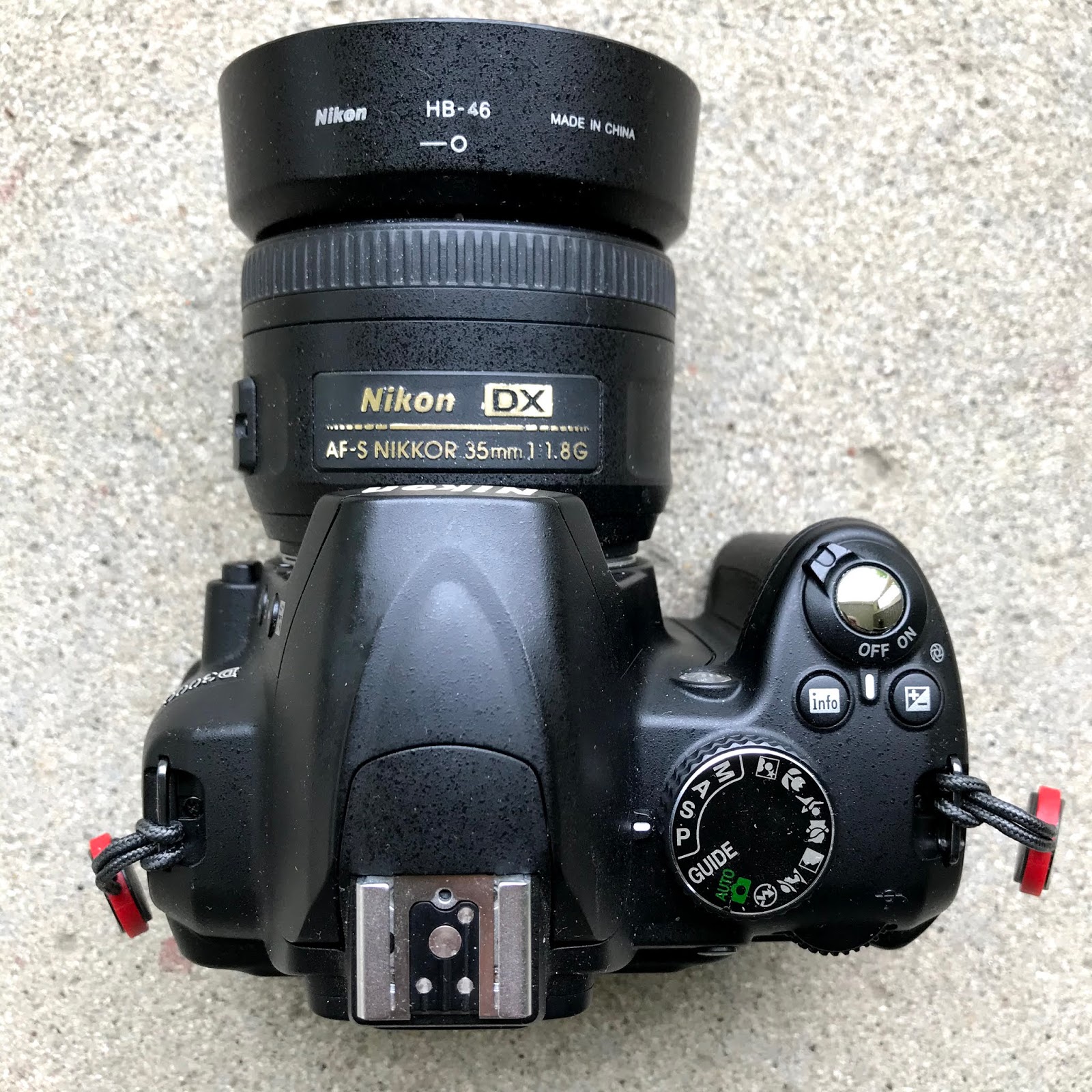
Nikon's excellent little 35mm f/1.8G is a great crop sensor prime, letting you isolate the subject and blue the background nicely.


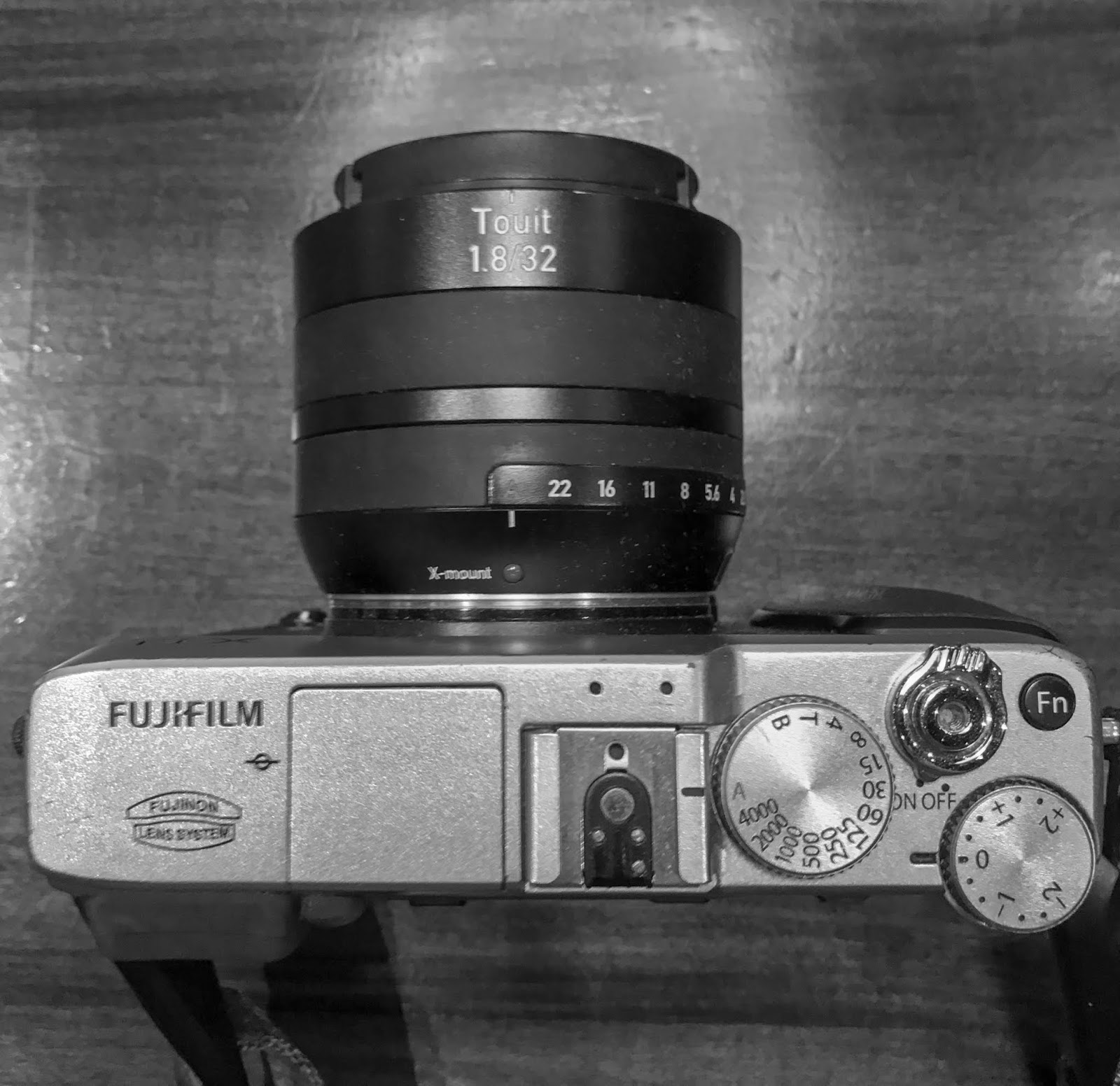
Fuji makes a few 35mm XF primes of varying prices and maximum apertures, but on my Fuji cameras I like the 32mm f/1.8 Zeiss Touit. If you really feel the need for speed on a budget, Sigma offers their 30mm f/1.4 Contemporary prime for the X-mount, too.


The Zeiss makes me happy...


Still, given the versatility of modern zoom lenses, I usually only break out the 50mm equivalent when I need the really fast aperture. They do see more use than my 35mm wide-ish angle primes, though.

It comes in handy with cameras that aren't great in low light, like the small-sensor Pentax Q series, which has an 8.5mm f/1.9 prime that's a 50mm equivalent.


10.15.2024

Lenses I Live By: 35mm


I'm not a wide-angle shooter by nature. I rarely use the wide end of zoom lenses, so wide primes are not a thing I typically have in my kit.

The widest prime lens I use with any regularity is the Fujifilm XF 23mm f/2 R WR. With a field of view equivalent to a 35mm lens on a full-frame body, the compact little "Fujicron" is fast, sharp, and (like it says on the label) weather resistant.

When I'm shooting with longer glass on my Fujifilm X-T2, I'll bring the XF 23mm f/2 along, mounted on my X-E1, to handle wide interiors, streetscapes, and other similar chores.

Plus, I really love the way it looks with that retro vented hood. I keep telling myself that I'll be an ace street photographer with this setup someday... someday. First I'll have to overcome my reluctance to get up in people's grilles with such a relatively wide lens, though.


6.18.2024

Small is Beautiful


An all-in-one "walking around" zoom lens is what's normally on my cameras. I like them because they're more versatile than a fixed focal length lens and have more reach than the typical 24-70mm pro zoom. They don't have as much reach as a superzoom. In non camera nerd speak, these are "5X" rather than "10X" zooms. 

The lack of focal length, however, is made up for by much better optics as well as larger available apertures over the most of the range of the lens. For instance, my favorite Nikon full-frame superzoom, the 28-200mm f/3.5-5.6, has a maximum aperture of f/3.5 at 28mm, while the 24-120mm f/4 VR is a third of a stop slower. But by the time you've zoomed out to 50mm, the 28-200 can only manage f/4.5, while the 24-120 will hold f/4 all the way out to 120mm.

The bigger hole lets in more light, allowing you to use lower ISOs or faster shutter speeds indoors or in the shade.

These lenses tend to be compact, but still fairly chonky, and that's one reason that smaller sensor cameras still appeal to me.

Thanks to the magic of crop factor, these are the equivalent lenses for full-frame, APS-C, and Micro 4/3rds:
That Micro 4/3rds lens on the Olympus, seen in the photo above, is almost an inch shorter, about a half inch smaller in diameter, and less than half the weight of the full-frame Nikon, yet it covers the same effective field of view and is a full stop brighter on the wide end, to boot. 

That's just shy of a pound's weight difference between the Nikon and Panasonic glass, and you notice that when it's hanging around your neck during a long day.


.

5.25.2024

5.07.2024

Mirrorless Pics: Neighborhood people with the Fuji X-E1


Some shots of the crew at Fat Dan's Chicago-Style Deli at 54th & College, using the Fujifilm X-E1 and the lovely little Zeiss Touit 32mm f/1.8 lens.

Being a roughly 50mm equivalent focal length, it's about as short of a lens as I'll ever use for portraiture, and its fast maximum aperture is good for making the subject stand out against a softly-blurred background. At the same time, f/1.8 and an APS-C size sensor is less likely to wind you up in those "Oops, I only had enough depth of field to get one eye in focus" situations than, say, f/1.4 on a full-frame.


4.20.2024

Fuji XF portrait lenses...

I really enjoy candid... well, technically I guess "casual" would be a more accurate term ...portrait photography. I'm usually relatively close to the subject, so anything in the 85mm to 135mm focal length (in full-frame terms) range generally works for what I'm doing. Probably a fast 85mm would be my favorite axe.

I would love to get a dedicated portrait lens for my Fujifilm XF cameras. I'm in more or less constant danger of winding up with their 56mm f/1.2 or 90mm f/2 if I find a deal on a used one.

The only thing that's saved me so far is that I got a smokin' deal at Roberts on a used XF 50mm f/2 R WR. While the 75mm equivalent focal length is a little shorter than I find ideal, it's compact, fast, and sharp as a tack. It sure spends a lot of time on my X-T2.


3.20.2024

Mirrorless Pics: Neighborhood people with the Fuji X-E1


These are straight-out-of-camera JPEGs from the Fujifilm X-E1 and the wonderful Zeiss Touit 32mm f/1.8. This is one of my favorite combos, pairing a compact rangefinder-style body with a nice, fast standard prime.


3.11.2024

Mirrorless Pics: Neighborhood people with the Fuji X-T2


The Fujifilm X-T2 is the least fossil-y camera I have. Despite being three generations old (Fuji's up to the X-T5 now) its release date in 2016 makes it the newest interchangeable lens camera I own.

As a result, the low-light performance is mind-boggling to me. If I'm shooting indoor candids by available light, I'll open the lens aperture wide and let the camera pick the ISO and shutter speed.

These photos were both shot with the Fujinon XF 50mm f/2 R WR lens cranked all the way open. The camera selected ISO 2000 for the upper pic and a whopping ISO 12800 for the lower.

The sharpness achieved at a five-digit ISO seems amazing, considering that a decade earlier anything over ISO 400 was an unusably noisy mess.


I really like the 50mm "Fujicron". It's so compact but offers a good focal length and fast aperture for indoor candids.

.

2.10.2024

Rounding Out a Lens Library

Fuji X-T2 & XF 50mm f/2 R WR

My lineup of Fujifilm X-mount lenses had a hole in it... Well, it had a couple holes, actually, but one really mattered to me.

I had a couple good primes: The wide-ish XF 23mm f/2 R WR "Fujicron" and the normal-length Zeiss Touit 32mm f/1.8, as well as a good general-purpose zoom in the XF 16-80mm f/4 R WR. What I didn't have was a dedicated portrait lens. Oh, sure, I had a manual focus Kamlan 50mm f/1.1 that I'd bought on a lark back when my income situation allowed buying lenses on a lark, but it didn't really fill the gap.

Fuji makes three lenses that would do the job I was looking for and were roughly in my price range: The 50mm f/2, 90mm f/2, and (if I really stretched and maybe traded in some old kit) the 56mm f/1.2

Fortunately a used 50mm f/2 R WR "Fujicron" popped up at Roberts downtown here in Indy at a price I could afford, and so I snatched it up.

Now I just need a longer telephoto zoom and I'll have a fairly complete shooting setup. I could do an event  with one bag, the X-T2 and the X-E1 as a backup.

2.04.2024

Mirrorless Pics: Downtown Indy with the Fujifilm X-E1

In my ongoing quest to try and "see" better in wider angles, I switched cameras halfway through my photo walk with a friend in downtown Indianapolis yesterday.


I bagged the  Fuji X-T2 and pulled the X-E1, wearing an XF 23mm f/2 R WR lens, out of my Peak Design  Everyday Sling.

On the X-E1's 16MP crop sensor, the XF 23/2 "Fujicron" has a field of view equivalent to about a 35mm lens on a full frame camera, so it's wide-ish but not really wide-wide.

One thing I like about the Fuji cameras is their film emulation modes, so you can get that Acros or Provia look without having to do processing. Of the mainstream manufacturers these days, Fuji is definitely the camera nerd's camera supplier.


Acros emulation

Provia emulation


1.09.2024

A Fuji complaint…

I really love my Fujifilm X-E1, but I have a beef with it.

Frequently I’ll use it as a backup body when I’m shooting my X-T2, hanging on a strap with a fast prime while I shoot the XF 16-80mm f/4 WR zoom on the main body.

The position of the exposure compensation dial on the X-E1’s top place, such that it’s flush with the rear edge, combined with the lack of a locking button on said dial, means that I’m often a couple shots into a scene before noticing that its been jostled a couple stops in either direction. This is especially bad when I find out I’ve underexposed the bejeezus out of an indoors shot or three.

12.11.2023

Mirrorless Pics: Obsidian knife with the Fujifilm X-E1


Every year since 2018, I've made a point of buying a knife from the flint knapper in the Pioneer Village at the Indiana State Fair. This one, with a blade of rainbow obsidian, was the first.

These photographs were taken with my Fujifilm X-E1, wearing the Zeiss Touit 32mm f/1.8 lens.

The X-E1 was Fuji's second camera in its X-mount lineup. It's essentially an X-Pro without the bulky and expensive electro-optical hybrid viewfinder. Instead, it has a conventional high-res OLED electronic viewfinder, albeit with higher resolution than the electro- part of the X-Pro's hybrid finder. It's also got a bit more plastic in the body shell than the rugged X-Pro. The 16MP APS-C X-Trans CMOS sensor is the same as the one on the more expensive camera.


11.16.2023

Fujifilm XQ1 review: Thumbs Down

So there was this time I fell in love with a pocket digicam, only for it to break my heart.

On paper, the Fujifilm XQ1 was my perfect pocket camera: The lens collapsed flat and the whole thing was the size of a deck of cards. It had a ginormous (for a pocket cam) 2/3" sensor. It had a 24-105mm equivalent zoom lens with a bright f/1.8-4.9 maximum aperture. It had those lovely Fuji colors and could shoot RAW with the full array of PASM modes.


It took great pictures!


Alas, the XQ1 has a known bug in that the aperture blades tend to get stuck wide open, and the camera's basically bricked when that happens, because it's long past the time when Fuji could repair it.

Get a Sony RX100 instead, the original one, used. Just as good a lens, same focal length range, bigger sensor.

.

11.09.2023

Mirrorless Pics: Huck the cat with a Fujifilm X-E1

Huck, the Miniature Broad Ripple Biting Tiger

The X-E1, released in late 2012, was their second mirrorless camera, after the widely-acclaimed X-Pro1. Dispensing with the X-Pro's expensive hybrid electro-optical viewfinder, the X-E1 had a high-res OLED electronic viewfinder instead, but shared the same 16MP APS-C X-Trans CMOS sensor with its pricier stablemate.

Both photos were taken using the Zeiss Touit 32mm f/1.8 lens.

Holden, the Northern Floofloaf


.

7.11.2020

Lungfish: Fujifilm FinePix S2 Pro

It seems oddly appropriate to kick off some intermittent posting on this dusty blog with a digital fossil that was not very fossilized when I started here back in '07. Heck, in 2007, the Fujifilm FinePix S2 Pro was barely dead; it didn't exit the catalog until the end of 2003, replaced by the S3 Pro.

Fuji was an early player in the digital photography world. In fact, when legendary German camera brand Leica decided to dip their toe in the consumer digital market, their first offerings were re-skinned Fujifilm digital cams.

During those early years, digital cameras were mostly novelty toys and the few professional digital cameras for use by photojournalists and such were collaborations between Kodak and film camera makers like Nikon and Canon, grafting a digital sensor made by the former onto a conventional film camera body made by the latter.

That early era of Frankenstein DSLRs would seem to have come to an end with Nikon and Canon launching their own entirely in-house offerings in 1999-2001, but there was one holdout.

See, Fujifilm was eager to get in on this DSLR action, and they had some interesting sensor technology to offer the market, but they didn't have a modern autofocus single lens reflex camera , having essentially bailed on the 35mm SLR market in the Eighties. So Fuji turned to a deal with Nikon, who would supply the actual camera bits, onto which Fuji would graft the digital sensor and hardware to make it work.

Fuji had worked with Nikon before, producing sensors for the company's early "E-series" DSLRs. Further, using Nikon hardware for their own DSLR launch would let Fuji buyers immediately piggyback off the vast Nikon F-mount lens library, so it seemed a win-win.

The initial offering from this pairing was the FinePix S1 Pro, which was built on a Nikon N60 body and had two marketing problems: First, asking people to shell out $3500 for a DSLR built on the chassis of a $300 entry-level film SLR is kind of a big ask. Second, Fuji marketing stumbled badly in the description of the sensor.

Fuji's SuperCCD sensor had 3.1 million photodiodes, but rather than arranging them horizontally & vertically, they were in diagonal rows and the resulting image was interpolated into a 6.2 megapixel image...so Fuji marketed the S1 as a 6.2MP camera. At the time, the $3,000 Canon D30 had a 3.1MP sensor and the $5,500 Nikon D1 had 2.7, so this was a big deal, at least until everyone started complaining about the actual number of photodiodes.


At any rate, the S1 Pro was succeeded in 2002 by the S2 Pro which was an upgrade in several ways. Importantly, it used the much more high-end Nikon N80 as the base camera, which made it feel a lot less chintzy and offered much-improved capabilities over the downmarket N60. Second, the new iteration of the SuperCCD had a 6.1MP sensor that, using the same interpolation method, turned out images of a jaw-dropping (for the time) 12MP resolution.


While the S2 was a modest success and was itself succeeded by a couple more iterations of Nikon-based cameras with Fuji sensors, Fuji eventually abandoned the DSLR market in '09 to concentrate on its mirrorless offerings.

A friend noticed this S2 Pro in a pawn shop, where it had languished for a while with a $50 price tag before moving to the bargain table, where it was scooped up along with several old video game carts and one of the old swivel-lens Nikon Coolpix cameras, the whole lot going for a Jackson. Not having much in the way of Nikon glass and knowing my love for weird old cameras, he passed the S2 Pro along.

It's an interesting artifact of its era. Its Frankenstein nature becomes apparent in that the Nikon camera part still runs on the same 2 CR123 batteries as a regular N80, but there's also a pull-out tray for four AA cells to power the grafted-on Fuji digital bits.


There are two card slots, but unlike modern systems, you have to decide in the menu whether you want to record to the SmartMedia or the CF card bay. It won't record to both simultaneously.


SmartMedia is a pretty well dead format, kept alive mostly because apparently some keyboards (the musical instrument, not the input device) use them. The largest SmartMedia cards only ran to 128MB, and I found a new-old-stock Fuji 32MB one on Amazon. Shooting in 12-bit CCD RAW, the 32MB card will hold precisely two images. Fortunately I have plenty of smallish CF cards formatted in FAT16 lying around from the D1x.

The top plate, at first glance, is straight-up Nikon N80. The difference is the Mode Dial, which has been replaced with one that adds the self-explanatory "ISO", whereby you adjust sensitivity by twiddling the Command Dial with the Mode Dial in this position, and the more cryptic "CSM", which puts you in the FinePix's Custom Settings Menu.


On the back of the camera is a small monochrome LCD for toggling through basic camera operations, as well as displaying ISO and resolution. Below that is a 1.8" color LCD for reviewing photos and the camera's basic setup menus: time & date, card formatting, CF/SmartMedia, color space, resolution, and suchlike.

One last feature that seems odd compared to modern DSLRs is the settings menu for the rear display. After every photo you can either have it off; set it to "postview", which is what we would call "preview" nowadays, showing the image you just took; set it to "preview", where it will display the image you just took and not actually record it until you press the F2 button; and "preview + histogram", which is what it sounds like.

I was stumped at first because it wasn't recording the pictures I had taken. This was because I had the camera set to "preview" using my current understanding of the term. Oops.

Once I got it figured out, though, I was pretty happy with the performance of the old SuperCCD...