Showing posts with label Nikon FX. Show all posts

8.30.2026

Time Continues to Fly Like an Arrow...

When I first got into DSLRs over a dozen years ago, the D4 was still the king of Nikon Hill. It was still a year or so away from getting supplanted by the D4S (which, as the name implies, was a fairly modest improvement not worth incrementing the model designation over) and stickered for something like six grand.

Now you can pick up nice used ones in the $5-700 range, less if you're willing to go with a cosmetic beater or high shutter count. (And when looking at shutter counts on used cameras, be aware that the Kevlar/carbon fiber unit on the D4 was supposed to be good for 400,000 activations, and there are examples running around with a lot more. Pro Nikons are ridiculously overbuilt.)

This was Nikon's second generation of full-frame pro body and featured a 16MP CMOS sensor and a continuous frame rate of up to 10fps for action shooting. This one has one CF slot and one XQD slot, although other configurations were available.


These beasts were built for pros whose work would wind up on the pages of National Geographic or Sports Illustrated. (In fact, Nikon and Canon pro bodies tend to iterate on cycles that roughly coincide with the Summer or Winter Olympics.)

It's a bit of overkill for casual photography around the neighborhood, but hey, there's no kill like overkill, amirite?

Most of my shooting with this one's been done with the supremely versatile 28-300mm f/3.5-5.6G VR superzoom.


1.09.2026

This Can't Be a Fossil Already, Can It?

The "fossil" cutoff here at Digital Fossils is ten years old and, while it feels like the Nikon Df is still a fairly new camera, it was actually released in time for Christmas of 2013, so it's a dozen years old.

I wanted one but they were $2,750 for just the body when they came out. By early 2020 used ones had dropped down to a grand or so, but between inflation and the fact that they started getting desirable, the price kinda hovered right around that spot. In fact, nicer ones are back up in the $1100-1200 range last I checked.

Finally one with a low shutter count (under 12,000 actuations) and enough cosmetic wear to make the price bearable came out on the shelf at Used Photo Pro downtown, so... happy early birthday to me!


It's an interesting combination of parts bin stuff from the cheaper consumer full-frame Nikons, the 16MP FX sensor from the pro D4, and those retro controls. Thom Hogan's review I think does it justice.

.

8.14.2025

Lenses I Live By: The Fast All-Purpose Zoom

I’ve blogged before in this series about “superzooms”, which a lot of folks call “vacation” lenses because they cover a wide range of focal lengths, from wide-angle to long telephoto, obviating the need to bring an array of different lenses on vacation with you.

Thing is, some of your vacation will likely take place indoors, while visits to the zoo tend to happen on nice days, hence why I call these zooms “zoo lenses”. The other thing is, the focal length range on these lenses… typically 7X to 10X …precludes both really excellent optical results across the entire focal length range, as well as necessitating slower apertures at longer focal lengths, making them less useful indoors or in otherwise questionable lighting conditions.

Alternatively, most manufacturers make zoom lenses with a slightly shorter focal length range, typically a 24-105mm or 24-120mm equivalent, but better optics and faster apertures, usually a constant f/4 across the whole range, or else an f/2.8-4 or something like that.

These are the real “leave it on the camera all the time” champs for me. They’re long enough for most things short of taking pictures of critters at a distance, and, with any sensor from about 2008 onward, capable of shooting indoors at ISO 800-1000 or so, especially with image stabilization of some sort on tap.


The classics of this genre are full frame lenses from the “Big Two”: Canon’s EF 24-105mm f/4L IS and Nikon’s 24-120mm f/4G VR.

On APS-C size sensors, these translate to 16-70mm and 16-80mm focal length ranges and the heavyweight champion here is the Nikon DX 16-80mm f/3.8-4E VR lens, maybe the best F-mount DX glass ever…


Lastly is my go-to for Micro Four Thirds, the Panasonic 12-60mm Leica DG Vario-Elmarit F2.8-4.0 ASPH, which is a 24-120mm equivalent in that format.


5.05.2025

DSLR Pics: Indiana State Fair with the Nikon D3


These photos are from the 2021 Indiana State Fair Pioneer Village, using a Nikon D3 and the 24-120mm f/4 VR zoom lens, which is an excellent and versatile all-purpose walking-around lens.


Dating from 2007, the D3 is quite long in the tooth, but it was Nikon's top-of-the-line pro body until it was supplanted by the D3S in late 2009.

It's got all the features you'd expect from a pro DSLR: tank-like build quality, full weather sealing, dual CF card slots, and 9 frames per second burst mode.


You can click on all these photos to see them in their full 12MP glory.


5.02.2025

DSLR Pics: Tractors at the State Fair with the Nikon D700


These are from the 2019 Indiana State Fair, using a Nikon D700 and a basic, inexpensive 24-120mm f/3.5-5.6 VR zoom lens.


Despite dating to 2008 and having "only" a 12MP full-frame (FX, in Nikon-ese) sensor, the D700 is still an extremely viable camera. They're built like tanks and there are examples running around out there with seven-digit shutter counts.

2.28.2025

Lenses I Live By: The Superzoom

They're generally called "superzooms", sometimes "all-in-one" or "vacation" lenses. I call them "zoo lenses" because they cover a wide enough spread of focal lengths to cover any shooting situation at the zoo, whether the critter is big and right in front of you, or small and way off in the back of its enclosure.

They typically have a 7X to 10X focal length range... wait, let me explain something.

Most people see the number followed by an "X" and assume it refers to view magnification, since that's what it signifies with telescopes and microscopes and the like. With cameras, however, it refers to the range of focal lengths.

A 35-70mm zoom lens would be a 2X zoom, going from a wide-ish viewing angle to the very shortest edge of telephoto. A 70-210mm would be a 3X, while a 24-240mm would be a 10X, et cetera.


The 12-200mm on the Olympus E-M1X in the photo above, the equivalent of a 24-400mm lens on a full-frame camera, is at the extreme end of superzoom ranges. It's able to shoot from comfortably wide angles to a very credible long telephoto length suitable for urban wildlife.


One of the first really good superzooms was Nikon's 28-200mm AF-D, which was replaced by the even more compact 28-200mm f/3.5-5.6G in 2003. Now discontinued, those lenses have gotten a little cult-y due to their small size and can fetch a premium on the used market.

Nikon D700, 28-200mm f/3.5-5.6G

The superzoom I get the most use out of is for DX Nikons, though: the 18-200mm f/3.5-5.6 VR II. I've used it on all my crop sensor Nikon DSLR bodies and the only one on which I don't like it is the D7100, as the 24MP sensor reveals its limitations. It's plenty sharp on the older D300S, though.

Nikon D300S, 18-200mm f/3.5-5.6 VR II

Basically, any time you're going someplace where you don't want to carry several lenses and have no idea what you're going to be shooting, the Superzoom is your Swiss Army knife lens. Vacation, the zoo, just walking around the neighborhood, it's your one-lens solution.

Quality ones tend to be moderately spendy, because there's a lot of optical jiggery-pokery happening in there to keep image quality reasonably decent, and they're not so hot for indoors or low light because of their fairly slow aperture range, but they're my go-to solution for a sunny day stroll around Broad Ripple if the squirrels are out and about.

11.02.2024

DSLR Pics: Triumph TR-3A with the Nikon D800


It's hard to believe that the Nikon D800 is over a decade old now. It's still an enormously capable camera and 36 megapixels is still rather a lot.

The image above, snapped on a Saturday afternoon in October, is a JPEG straight out of the camera. Like with all my cameras that can shoot RAW, I have the camera record one RAW file and one high quality monochrome JPEG. The reason for the JPEG is because that's the photo that gets shown for review on the monitor on the back of the camera when I chimp, and it keeps my head in that "light and shadow and texture" frame of mind.

Sometimes the JPEG itself is actually a keeper, too, like the one above. It should embiggenate quite nicely.  It was shot at ISO 200 and the lens was the 24-120mm f/4 VR zoom.

The actual color photo processed from the RAW is below.


.

6.18.2024

Small is Beautiful


An all-in-one "walking around" zoom lens is what's normally on my cameras. I like them because they're more versatile than a fixed focal length lens and have more reach than the typical 24-70mm pro zoom. They don't have as much reach as a superzoom. In non camera nerd speak, these are "5X" rather than "10X" zooms. 

The lack of focal length, however, is made up for by much better optics as well as larger available apertures over the most of the range of the lens. For instance, my favorite Nikon full-frame superzoom, the 28-200mm f/3.5-5.6, has a maximum aperture of f/3.5 at 28mm, while the 24-120mm f/4 VR is a third of a stop slower. But by the time you've zoomed out to 50mm, the 28-200 can only manage f/4.5, while the 24-120 will hold f/4 all the way out to 120mm.

The bigger hole lets in more light, allowing you to use lower ISOs or faster shutter speeds indoors or in the shade.

These lenses tend to be compact, but still fairly chonky, and that's one reason that smaller sensor cameras still appeal to me.

Thanks to the magic of crop factor, these are the equivalent lenses for full-frame, APS-C, and Micro 4/3rds:
That Micro 4/3rds lens on the Olympus, seen in the photo above, is almost an inch shorter, about a half inch smaller in diameter, and less than half the weight of the full-frame Nikon, yet it covers the same effective field of view and is a full stop brighter on the wide end, to boot. 

That's just shy of a pound's weight difference between the Nikon and Panasonic glass, and you notice that when it's hanging around your neck during a long day.


.

3.01.2024

High ISO

Canon EOS-1D MkIII & 24-105mm f/4L IS, ISO 3200

While the Nikon D1X could go up to ISO 800 and the Canon EOS-1Ds Mark II went all the way to 1600, I was leery of using either one at more than ISO 400 for fear of unusable amounts of noise.

It wasn't until 2007, with the release of the Canon EOS-1D Mark III and the Nikon D3 that 1600 and 3200 became practical settings, at least in my opinion.

This seems impossibly quaint here in 2024, when I'm seeing friends posting images from Canon R6's and Nikon Z7 II's at five-digit ISOs with no really noticeable noise, but it was a big deal back then.

Nikon D3 & 24-120mm f/4G VR, ISO 1600


2.24.2024

The Wrong Lens

I almost threw the big 80-400mm f/4.5-5.6D VR lens on the Nikon D3 when I headed out the door for lunch yesterday, but opted to stick with the old 80-200mm f/2.8D push-pull zoom instead.

The latter doesn't have as much reach, but it's lighter and less bulky, and the fast aperture makes it a pretty fair jackleg portrait lens.

So of course I no sooner round the corner at the end of the block than I encounter three squirrels chasing each other all over a tall-ass oak tree.


A 200mm lens on a full-frame camera is long, but not wildlife-photography-long. On top of that, the 12MP sensor of the old D3 doesn't give a ton of leeway for saving a marginal shot by cropping the bejeezus out of it.

.

1.24.2024

DSLR Pics: Monochrome shots with the Nikon D3

I was out and about in the neighborhood on a drizzly January day with the Nikon D3 wearing an old original late-'80s vintage push-pull AF Nikkor 80-200mm f/2.8 telephoto zoom lens.

It was a good day for monochrome in SoBro...


The fast f/2.8 maximum aperture will even let you do some indoor available light work if you're willing to push the ISO up to 1600 or 3200...


The drizzly weather made for some dramatic effects in the dim evening light...


1.07.2024

A Tale of Two Nikons, Part Two

History is replete with examples of super-powered dynamic duos: Batman and Robin, Ruth and Gehrig, Swift and Kelce, Pinky and The Brain.

If you're a Nikon fan you could add to that list the D3 and D700.

That pair was actually a successful reboot of an iconic power couple from the closing days of the film era. Nikon's F5 was a bombshell professional grade camera that arguably established the shape and size of future pro bodies from all the serious manufacturers. It was packed to the gills with the latest technology 1996 could conjure, and it had a built-in vertical grip that both made it easier to use in portrait mode and also held the eight AA batteries that, at eight frames per second, could suck up a 36 exposure roll of Velvia in about the time it takes you to say "Whoops! I totally forgot that film costs money!"

The F5 was an enormous, heavy, incredibly rugged camera, which you could use to bludgeon someone into unconsciousness and then take perfectly-exposed, crisply-focused pictures of the crime scene.

So in 1999 they gave it a little brother in the form of the F100. Still rugged, still weather-sealed, but it lost the bulbous vertical grip and its cavernous battery compartment. This shaved three and a half frames per second off the frame rate, but it also shaved a whole pound off its bulkier sibling's avoirdupois, from 2.75 pounds to 1.73, batteries included.

The F100 was popular with photogs who worried about weight or wanted something a little more discreetly-sized than the enormous full-on pro F5, as well as making an excellent second body for the traveling professional photographer.

Fast forward to 2007 and Nikon released the D3, its first DSLR to sport a full-frame sensor, which they dubbed "FX" format in Nikon marketing-speak. Nikon's first two generations of digital pro bodies, the D1 and D2, were like the F5 in size, shape, features, and ruggedness, but housed a smaller APS-C DX sensor. Since Canon had full-frame bodies in its lineup since 2002, Nikonians had been itching for a return salvo for five long years.

The D3 was an enormous pro camera, though, with a price tag to match. So the following year's announcement of the D700, which was lighter and smaller and less expensive without sacrificing important features or essential ruggedness or... most importantly ...that big 12MP CMOS sensor, was greeted with hosannas.

Of course, what good is a smaller, lighter camera without smaller, lighter lenses?

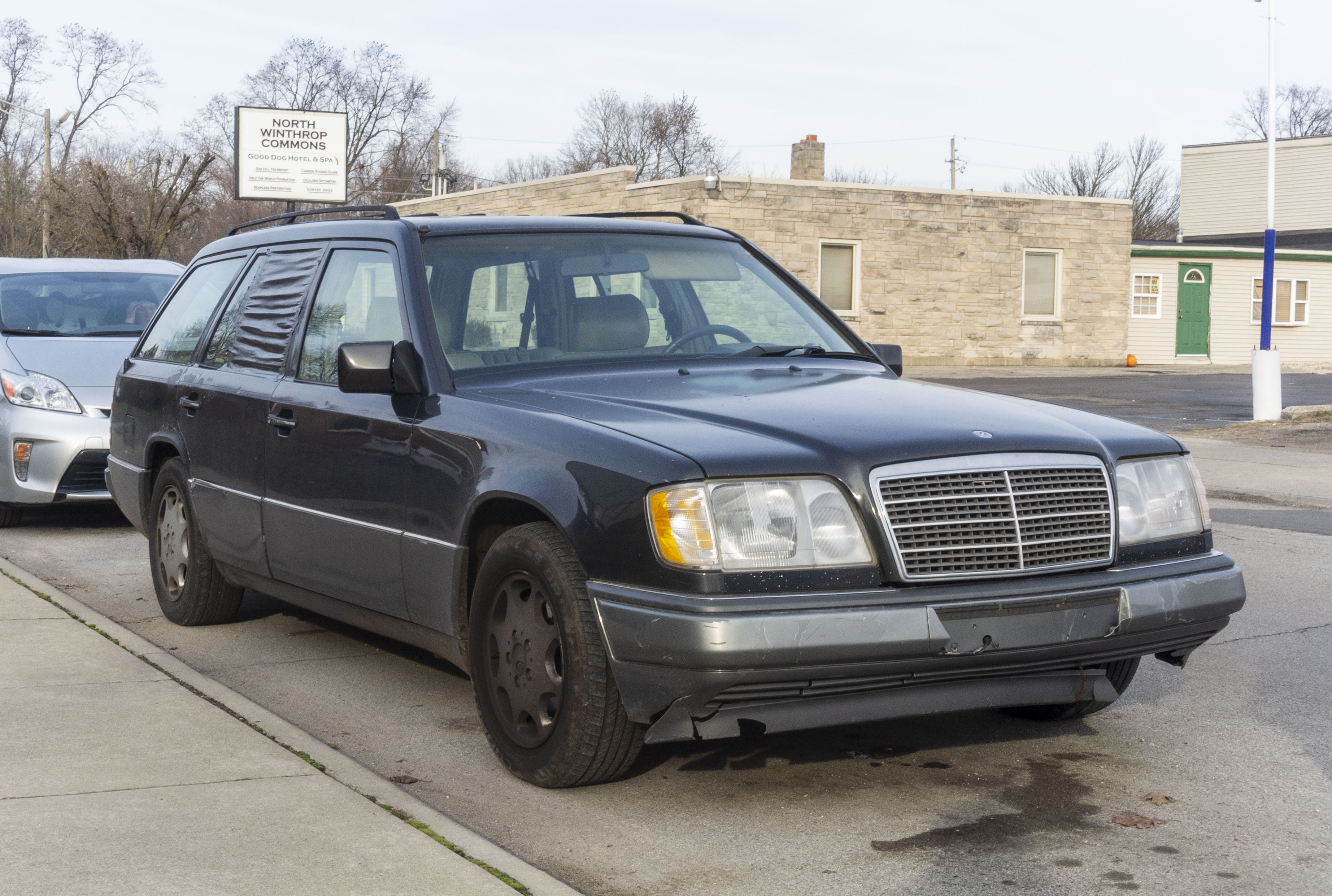
Hey, look at this mid-'90s Mercedes-Benz E320 wagon I snapped using the Nikon D700 and 28–200 mm f/3.5-5.6G zoom lens!


The 28-200mm G is tiny and light for its focal length range, much smaller and lighter than my rugged old 24-120mm f/3.5-5.6D "Street Sweeper".

It's not without its downsides. The lightness comes from its construction, with both the barrel and mount made of plastic. You wanna remember that plastic mount if you have it mounted on a D3; with a regular metal-mount lens you can pick up even a heavy Nikon pro body by the lens, but I wouldn't do that with a 28-200G.

The small size comes from the lack of a manual aperture ring, as well as the lack of a Vibration Reduction system or an internal focusing motor. Unless your camera has an in-body focusing motor, this is a manual focus only lens. And even with autofocus it can be slow to travel from one extreme of the focusing range to the other.

But it gives great results, all things considered, and did I mention it's crazy small and light? Jim Grey reviews it here, Ken Rockwell here, and there's a fascinating piece by the gentleman who designed the lens here. 

I snapped the same Mercedes wagon with the Nikon 1 J1.


It really gives you an idea for the effect of sensor size on depth of field. The little 1" sensor J1 was shooting at f/4.8, while the big full-frame D700 was shooting at f/7.1, yet there's enough background blur with the latter to really make the subject pop.

I like the Nikon 1 J1, but I love the D700.

. 

1.06.2024

A Tale of Two Nikons, Part One

I was out walkabout yesterday with a pair of Nikons.

One was sleek and modern looking, even slightly futuristic. When it came out in 2011, it was the wave of the future; compact and mirrorless with an electronic shutter and live view. 

The other was big and clunky, a stylistic throwback to Nikon's pro bodies of the late Nineties. While it made a splash on its release in 2008 for being a full-frame Nikon with a number on its price tag lower than the ones usually associated with a decent used car, it was actually an atavistic throwback.  

In 2008 a camera with a flappy mechanical mirror was like a late Cretaceous dinosaur; a magnificently evolved beast with no idea that there was a mirrorless asteroid only a decade away from smashing into the market.

Yet the mirrorless Nikon 1 J1 is a footnote, a failed branch on the Nikon evolutionary tree, while the D700 is a photographic Tyrannosaurus rex: extinct, but a legend.

Inside the body of the J1 is a 10MP CCD sensor by Aptina. It was a 1" sensor, a common size for luxo enthusiast compacts, but Nikon has to make up names, so it's a "CX" format sensor, to match "DX" (which everyone else calls APS-C) and the full-frame FX.

The 1" size is the biggest of the small sensors, in much the same way that Four Thirds is the smallest of the big sensors. It's physically large enough that with a large enough aperture you can actually get some background blur, and you can shoot as high as ISO 400 without horrific amounts of noise.

Hey, look at this Camaro Z28 I photographed with the J1!


The J1 was the cheaper half of a two-camera Nikon 1 ecosystem when it came out, with a more poshly-appointed V1 model above it. They used the same lenses and sensor, though.  

I had the kit lens on the camera for my walk. This is a 10-30mm f/3.5-5.6 VR affair that collapses to a reasonably compact size. With this lens the J1 is pocketable, provided we're talking about the sort of roomy pockets found on coats and jackets, not the trouser sort.

Poking a button on the side of the lens barrel and giving the rubber-coated zoom ring a twist will extend the lens and power up the camera. Now you have a 27-82mm equivalent zoom lens that will focus anywhere from eight inches out to infinity (or the end of the universe, whichever comes first.)

I should point out that when I say that the J1 was the cheaper of the Nikon 1 duo, that doesn't mean it was, you know, inexpensive. The body and lens combo I was holding came as a kit for $650 back in 2011, which is the equivalent of nine hundo today. Even back then you could get a beginner DSLR kit for about that price; Nikon's own D3100 went for $699 with a kit zoom.

I also snapped the Camaro with the D700, which had a 28-200mm f/3.5-5.6 AF-G zoom lens parked in front of its twelve megapickle full-frame CMOS sensor... but we'll talk about the D700 and that swoopy little superzoom in the next post.


11.20.2023

Nikon D800: High Resolution Fossil

It's hard to believe that we're coming up on a dozen years since the launch of the Nikon D800. It was such a huge deal when it launched!

In the spring of 2012, its only full-frame rivals were the Canon EOS 5D Mark III and the recently-discontinued Sony Alpha 900, with 22MP and 24MP sensors, respectively.

In contrast, the D800's 36MP sensor had resolution close to that of the medium format Pentax 645D, and for a third of the price. (I mean, three grand was still a lot of money, but...)

Nowadays you can pick up used D800s in the $400-$600 range from reputable resellers like KEH and Roberts. Just be aware that if you want best sharpness you need to use good lenses! I usually keep my 24-120mm f/4 VR on my D800 body.


11.06.2023

Which to buy: Nikon Df or Nikon D4s?

Jim Grey at Down the Road posted another batch of photos from his Nikon Df today.

I've had a low-key hankering for one since the first time I saw it. It used to be because I pined for classic dial & knob controls, but that was before I really learned to use the wheels on a modern DSLR. (There's a reason that pro cameras have used the dual wheel setup since the days of the Nikon F5 and Canon EOS-1 film cameras, and it's not because professional sports photographers can't figure out knobs and dials.)

My hankering for the Df, therefore, is purely nostalgic these days, but there's another reason for it.

I use Canons for work, so my old Nikons are purely for fun. Because of that, I'm not going to dump a ton of money into Nikon lenses. And because of that, there's only one lens I own that really works well on my Nikon D800: the 24-120mm f/4G VR. The D800 is a fantastic camera, but the 36MP sensor really reveals the weaknesses of cheaper lenses, especially non-stabilized ones.

The 16MP sensor in the Df would offer more resolution than my D3 or D700 while still working well with older/cheaper glass.

There was a time, not too many years ago, when prices on used Nikon Df bodies had slumped down around nine hundred bucks or so. I should have bought one then.

These days, prices on the collectible Df have crept up to the $1200-1300 mark. Meanwhile, prices on the Nikon D4 and D4s pro bodies have slipped below a grand. Heck, you can get a D4 for under $800 if you shop around.

The D4 has the same 16MP sensor as the Df.

The Df has those vintage looks and old-fashioned knobs. The D4 has everything else: Rugged pro body construction, twice the frame rate in burst mode, a monster battery, the vertical grip and shutter release, et cetera.

When I first started pricing them, it was the D4 that was way more expensive and the Df made sense. With the price tags swapped out, however, the D4 is looking like the no-brainer for me.

Plus I have a real weakness for pro bodies.

Which would you pick?

.