A sensible person would sell the a77 when she was done writing up the blog piece, but I really like a couple of the a-mount lenses and I am not very sensible.
Showing posts with label 2011. Show all posts
2.12.2026
1.10.2026
DSLR Pics: Neighborhood people with the Sony a77
The Sony a77 isn't technically a DSLR. Unlike a single lens reflex camera, in which the mirror flips up out of the way to clear the light path to the shutter and sensor or film, the mirror in the a77 is a pellicle style mirror and fixed in place.
The pellicle mirror lets most of the light pass through to the sensor while reflecting some of it upward. Where the prism or mirror box would be on a normal SLR was a phase detection autofocus sensor. The viewfinder was electronic, like on a mirrorless camera. Mirrorless cameras of the time could only use contrast detection autofocus, which was much slower and more prone to focus hunting.
Sony called these Single-Lens Translucent, or "SLT" cameras. Further developments in sensor tech rendered this obsolete in fairly short order. The SLT era at Sony was brief, with the first being launched in 2010 and the final model appearing in 2016.
5.23.2025
DSLR Pics: Straight-out-of-camera JPEGs from the Sony a700
The Sony 16-50mm f/2.8 lens is downright petite when compared to the Canon EF-S 17-55mm f/2.8 IS or the Nikon 17-55mm f/2.8 G lenses, but it still gives really excellent results. (It's an inch shorter and nearly a half pound lighter than the monster DX Nikon pro glass.)
The a700's sensor is modern enough that ISOs as high as 800 or 1000 still give pretty acceptable results.
1.07.2024
A Tale of Two Nikons, Part Two
History is replete with examples of super-powered dynamic duos: Batman and Robin, Ruth and Gehrig, Swift and Kelce, Pinky and The Brain.
If you're a Nikon fan you could add to that list the D3 and D700.
That pair was actually a successful reboot of an iconic power couple from the closing days of the film era. Nikon's F5 was a bombshell professional grade camera that arguably established the shape and size of future pro bodies from all the serious manufacturers. It was packed to the gills with the latest technology 1996 could conjure, and it had a built-in vertical grip that both made it easier to use in portrait mode and also held the eight AA batteries that, at eight frames per second, could suck up a 36 exposure roll of Velvia in about the time it takes you to say "Whoops! I totally forgot that film costs money!"
The F5 was an enormous, heavy, incredibly rugged camera, which you could use to bludgeon someone into unconsciousness and then take perfectly-exposed, crisply-focused pictures of the crime scene.
So in 1999 they gave it a little brother in the form of the F100. Still rugged, still weather-sealed, but it lost the bulbous vertical grip and its cavernous battery compartment. This shaved three and a half frames per second off the frame rate, but it also shaved a whole pound off its bulkier sibling's avoirdupois, from 2.75 pounds to 1.73, batteries included.
The F100 was popular with photogs who worried about weight or wanted something a little more discreetly-sized than the enormous full-on pro F5, as well as making an excellent second body for the traveling professional photographer.
Fast forward to 2007 and Nikon released the D3, its first DSLR to sport a full-frame sensor, which they dubbed "FX" format in Nikon marketing-speak. Nikon's first two generations of digital pro bodies, the D1 and D2, were like the F5 in size, shape, features, and ruggedness, but housed a smaller APS-C DX sensor. Since Canon had full-frame bodies in its lineup since 2002, Nikonians had been itching for a return salvo for five long years.
The D3 was an enormous pro camera, though, with a price tag to match. So the following year's announcement of the D700, which was lighter and smaller and less expensive without sacrificing important features or essential ruggedness or... most importantly ...that big 12MP CMOS sensor, was greeted with hosannas.
Of course, what good is a smaller, lighter camera without smaller, lighter lenses?
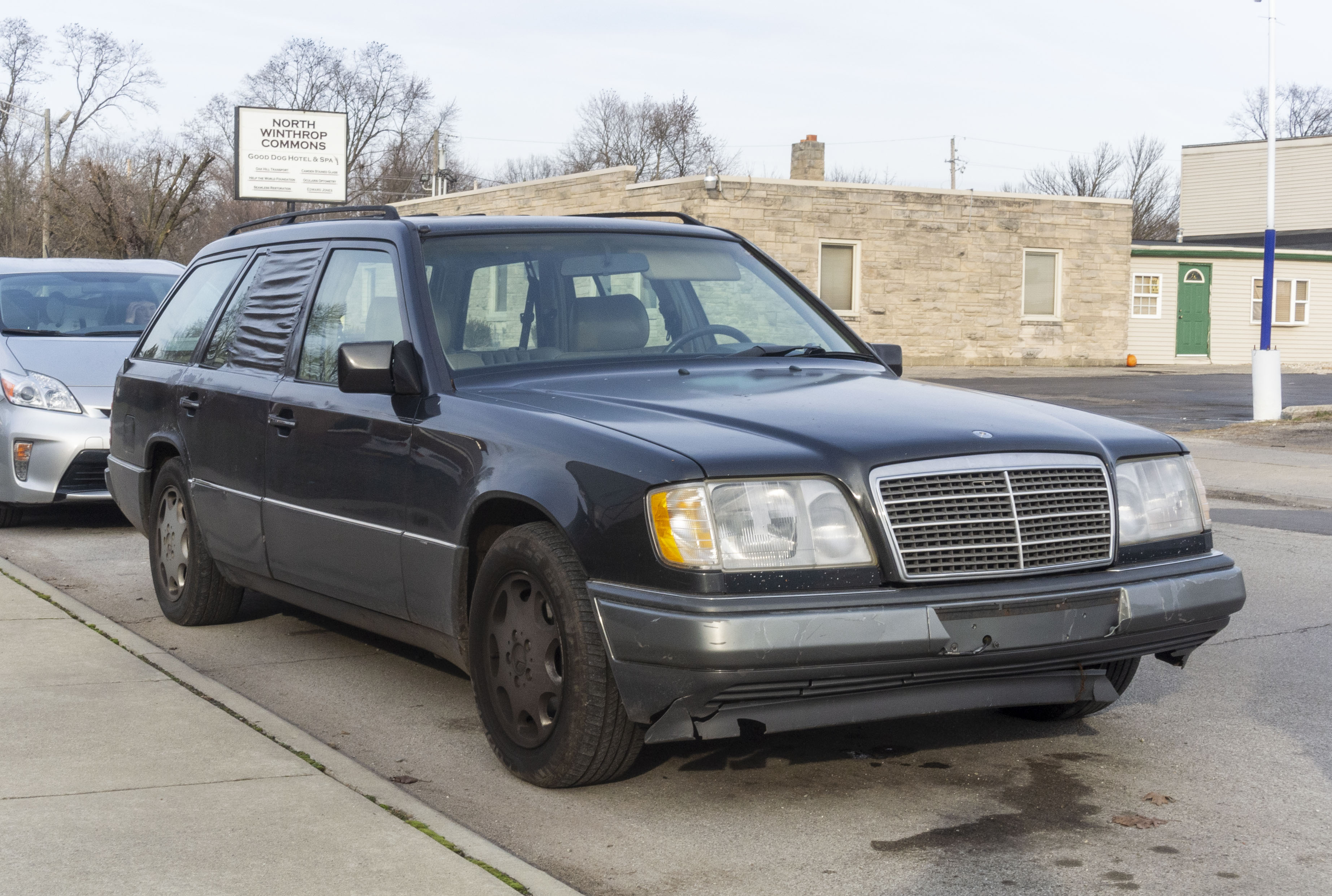
Hey, look at this mid-'90s Mercedes-Benz E320 wagon I snapped using the Nikon D700 and 28–200 mm f/3.5-5.6G zoom lens!
The 28-200mm G is tiny and light for its focal length range, much smaller and lighter than my rugged old 24-120mm f/3.5-5.6D "Street Sweeper".
It's not without its downsides. The lightness comes from its construction, with both the barrel and mount made of plastic. You wanna remember that plastic mount if you have it mounted on a D3; with a regular metal-mount lens you can pick up even a heavy Nikon pro body by the lens, but I wouldn't do that with a 28-200G.
The small size comes from the lack of a manual aperture ring, as well as the lack of a Vibration Reduction system or an internal focusing motor. Unless your camera has an in-body focusing motor, this is a manual focus only lens. And even with autofocus it can be slow to travel from one extreme of the focusing range to the other.
But it gives great results, all things considered, and did I mention it's crazy small and light? Jim Grey reviews it here, Ken Rockwell here, and there's a fascinating piece by the gentleman who designed the lens here.
I snapped the same Mercedes wagon with the Nikon 1 J1.
It really gives you an idea for the effect of sensor size on depth of field. The little 1" sensor J1 was shooting at f/4.8, while the big full-frame D700 was shooting at f/7.1, yet there's enough background blur with the latter to really make the subject pop.
I like the Nikon 1 J1, but I love the D700.
.
Labels:
2008,
2011,
digital photography,
DSLR,
MILC,
Nikon,
Nikon 1,
Nikon CX,
Nikon FX,
old digicams
1.06.2024
A Tale of Two Nikons, Part One
I was out walkabout yesterday with a pair of Nikons.
One was sleek and modern looking, even slightly futuristic. When it came out in 2011, it was the wave of the future; compact and mirrorless with an electronic shutter and live view.
The other was big and clunky, a stylistic throwback to Nikon's pro bodies of the late Nineties. While it made a splash on its release in 2008 for being a full-frame Nikon with a number on its price tag lower than the ones usually associated with a decent used car, it was actually an atavistic throwback.
In 2008 a camera with a flappy mechanical mirror was like a late Cretaceous dinosaur; a magnificently evolved beast with no idea that there was a mirrorless asteroid only a decade away from smashing into the market.
Yet the mirrorless Nikon 1 J1 is a footnote, a failed branch on the Nikon evolutionary tree, while the D700 is a photographic Tyrannosaurus rex: extinct, but a legend.
Inside the body of the J1 is a 10MP CCD sensor by Aptina. It was a 1" sensor, a common size for luxo enthusiast compacts, but Nikon has to make up names, so it's a "CX" format sensor, to match "DX" (which everyone else calls APS-C) and the full-frame FX.
The 1" size is the biggest of the small sensors, in much the same way that Four Thirds is the smallest of the big sensors. It's physically large enough that with a large enough aperture you can actually get some background blur, and you can shoot as high as ISO 400 without horrific amounts of noise.
Hey, look at this Camaro Z28 I photographed with the J1!
The J1 was the cheaper half of a two-camera Nikon 1 ecosystem when it came out, with a more poshly-appointed V1 model above it. They used the same lenses and sensor, though.
I had the kit lens on the camera for my walk. This is a 10-30mm f/3.5-5.6 VR affair that collapses to a reasonably compact size. With this lens the J1 is pocketable, provided we're talking about the sort of roomy pockets found on coats and jackets, not the trouser sort.
Poking a button on the side of the lens barrel and giving the rubber-coated zoom ring a twist will extend the lens and power up the camera. Now you have a 27-82mm equivalent zoom lens that will focus anywhere from eight inches out to infinity (or the end of the universe, whichever comes first.)
I should point out that when I say that the J1 was the cheaper of the Nikon 1 duo, that doesn't mean it was, you know, inexpensive. The body and lens combo I was holding came as a kit for $650 back in 2011, which is the equivalent of nine hundo today. Even back then you could get a beginner DSLR kit for about that price; Nikon's own D3100 went for $699 with a kit zoom.
I also snapped the Camaro with the D700, which had a 28-200mm f/3.5-5.6 AF-G zoom lens parked in front of its twelve megapickle full-frame CMOS sensor... but we'll talk about the D700 and that swoopy little superzoom in the next post.
Labels:
2008,
2011,
camera reviews,
digital photography,
DSLR,
MILC,
Nikon,
Nikon 1,
Nikon CX,
Nikon FX,
old digicams
12.08.2023
The Pentax Q: A review.
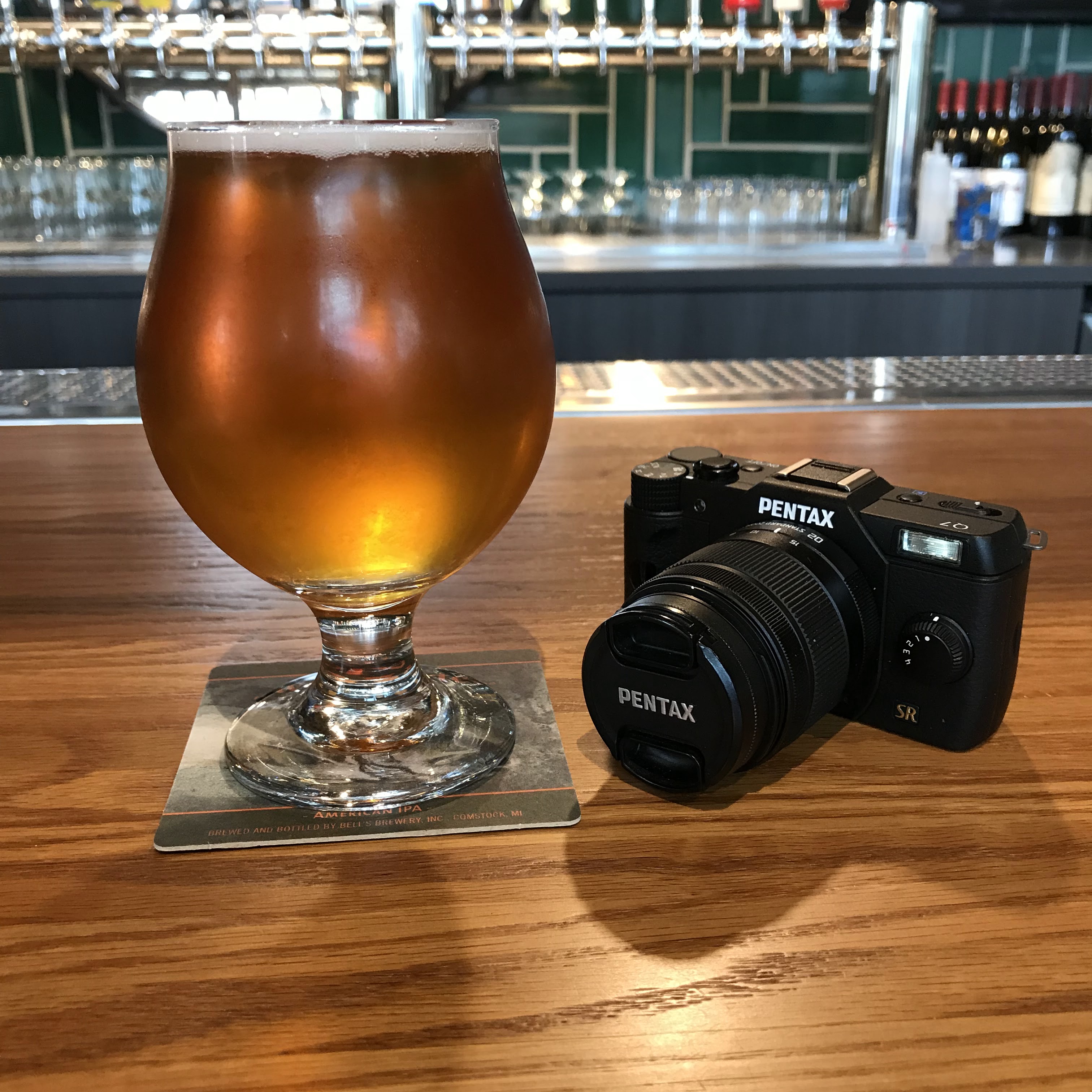
The original Pentax Q, which debuted in the summer of 2011, was the most conventionally-styled of the Q-series cameras. It also featured the highest level of build quality.
Its sturdy magnesium shell was shaped sort of like a little rangefinder camera, albeit with a little hump just big enough to emblazon with the PENTAX name under the accessory shoe, where the viewfinder hump would be on an SLR-type camera. Despite that, there is no viewfinder, either electronic or optical; image composition must be done on the rear screen like with a point & shoot. Sacrifices must be made on a camera this small.
There's no sacrifice in the physical control department, however, unlike the early mirrorless efforts from Canon and Nikon.
Atop the camera at the front right-hand corner of the top plate is a prominent dial with the full array of PASM modes, as well as positions for Auto, Scene (the usual array of Portrait, Landscape, Action, Candlelight, etc. modes), Movie, and a setting called BC, which stands for "Blur Control" and will render some "fauxkeh" artificial background blur, with about as much sophistication as you could expect from a 2011 camera. The Blur Control setting allows shooting in JPEG only, obviously.
Immediately abaft of the mode dial is another control wheel, positioned at the right rear corner of the top plate where it can easily be twiddled by the thumb on the shooting hand. This controls the aperture or shutter speed in the appropriate mode, shifts the program in "P", and controls zoom when reviewing images in playback mode.
Immediately to the left of these dials are the shutter release and the tiny On/Off button, which is slightly recessed so as not to get jostled inadvertently. On the other side of the accessory shoe, on the left side of the top plate, are the playback button and the switch to pop the flash up. (And oh boy does the flash ever pop up, on a complex double-jointed arm that gives a surprising amount of offset from the lens axis.)
The back of the camera is pretty conventional mirrorless camera, albeit shrunk to fit. There's a bright 3" TFT LCD monitor with 460,000 pixel resolution taking up most of the real estate, while the right edge has the stack of little chiclet control buttons. On the front of the body are a focus assist lamp, lens release button, and a little dial that lets you select four user-definable presets.
The solidly-built metal-bodied original Q was a spendy little toy. Initial MSRP in 2011 was $800 with the 8.5mm f/1.9 kit lens, with the 5-15mm f/2.8-4.5 02 Standard Zoom available for another $299. That's the equivalent of $1100 and $400 in 2023 dollars. By way of comparison, the Canon Rebel T3i and Olympus PEN E-P3 were both priced at $899 with a kit zoom in camera stores at the time.
The Rebel T3i had an 18MP APS-C sensor and the Oly PEN E-P3 had a 12MP Four Thirds sensor, while the Pentax Q had a 12MP 1/2.3" BSI CMOS sensor, the size of ones most commonly found in point & shoot pocket cameras. It wasn't exactly a low-light beast, but between the reasonably fast lenses and Pentax's built-in Shake Reduction sensor-based image stabilization, it did okay.
The following shots were all taken with the 01 Standard Prime lens and shot in RAW (DNG) format, converted via Photoshop's built-in convertor.
Labels:
2011,
camera reviews,
digital photography,
MILC,
old digicams,
Pentax,
Pentax Q
12.06.2023
Mini Mirrorless: The Pentax Q Series
Back at the dawn of the mirrorless age the cameras themselves took two different approaches.
For Panasonic and Sony, who didn't have long photographic lineages, and Olympus, who had basically started over from scratch in the digital era, they quickly moved to become standard cameras; competitors (and eventual replacements) for the classic SLRs.
For Canon, Nikon, and Pentax, who were all invested in digital systems that had physical ties back to their film legacies, there was a struggle to find a niche for these new cameras that didn't take market share from their established DSLR lines.
Pentax's solution was to go back to an older camera of theirs for inspiration...
Pentax's mirrorless entrant used a tiny 12MP 1/2.3" sensor, the size usually associated with pocket point and shoot cameras. They boasted that the new Pentax Q was the smallest interchangeable lens system camera on the planet.
While the initial Q was magnesium-bodied and came in white and black, Pentax went full kawaii with the later plastic-bodied models... the Q10, Q7, and Q-S1 ...and made them available in every color of the rainbow.
Because of the tiny sensor, the lenses could be made commensurately smaller and lighter. In the photo below is a Pentax Q-S1 with normal prime, standard zoom, telephoto zoom, and fisheye lenses.
The body and all four lenses combined weigh only a hair over one pound!
I don't know which I like better, the cheerfully colored models, or my all-black Q7, which looks like a regular DSLR unless you have an object of a known size nearby to provide scale...
Over the next couple weeks I hope to do an in-depth look at each of the four models, as well as the lenses I have on hand.
.
Labels:
2011,
digital photography,
MILC,
old digicams,
Pentax,
Pentax Q
11.25.2023
Nikon 1 V1 and the 1 Nikkor 18.5mm f/1.8
On the little 1" sensor (or, as Nikon called it, "CX format") of the V1, the 1 Nikkor 18.5mm f/1.8 is the equivalent of the Nifty Fifty.
The f/1.8 aperture is nice and bright, but while the aperture doesn't scale in terms of brightness, it does in regard to depth of field. When it comes to blowing out the background, even wide open the maximum aperture is equivalent to f/4.86 on a full frame camera.
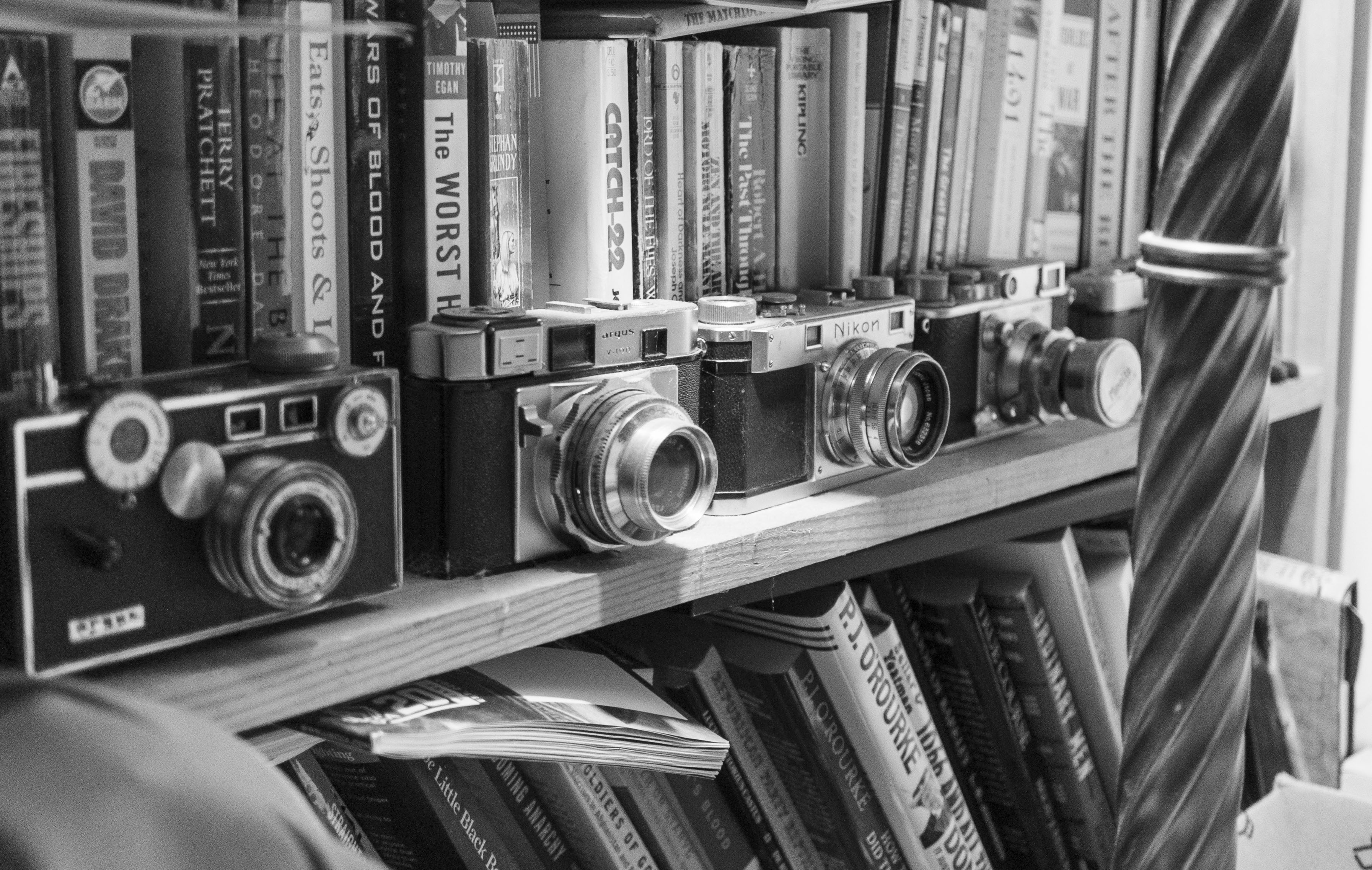
That's not necessarily a bad thing, though! Check out this wide open shot of some cameras on a bookshelf. On a full-frame body it would have had a depth of field about as thick as a sheet of paper, whereas here all the titles are legible.
11.11.2023
Mirrorless Pics: Portraits with the 1 Nikkor 32mm f/1.2
Easily the best lens in the entire lineup for the CX-format Nikon 1 mirrorless system, the 1 Nikkor 32mm f/1.2 is the equivalent of an 85mm lens on a full frame camera.
Despite the tiny 1" sensor, the f/1.2 maximum aperture can even manage a bit of background separation.
85mm is a classic focal length for portraiture and when you shrink it down to match the Nikon 1 format and put it on a little camera like a 1 V1 or V2, it doesn't feel as intimidating for subjects as would getting up in their grille with a big full-frame 85mm f/1.4.
Labels:
2011,
2012,
2013,
digital photography,
MILC,
Nikon,
Nikon 1,
Nikon CX,
old digicams
11.07.2023
Mirrorless Pics: Around SoBro with the Pentax Q
The tiny little Pentax Q came out in 2011, touted as the smallest interchangeable lens system camera, and it is twee indeed. It vibes like an update of Pentax's old 110 SLR system.
These were both shot in RAW and just run through the Photoshop converter by poking the Lens Correction, Adobe Vivid, and Auto buttons.
![]() |
| Pentax Q with a Nikon D700 for scale. |
The Q system numbers its lenses, and the first two released were the 01 Standard Prime, which is an 8.5mm f/1.9, and the 02 Standard Zoom, which is a 5-15mm f/2.8-4.5. Both lenses have built-in leaf shutters.
Constructed with a very solid-feeling aluminum body, the Q has a 1/2.3" sensor, of a size more commonly associated with pocket point & shoots and cell phone cams. Thanks to the tiny sensor's crop factor, that gives the 01 Prime the equivalent field of view to a 47mm lens on a full-frame camera, and the 02 Zoom a 28-83mm equivalent field of view.
Here's the SoBrosaurus at the widest angle with the 02 Zoom...
These were both shot in RAW and just run through the Photoshop converter by poking the Lens Correction, Adobe Vivid, and Auto buttons.
Here are a couple more pictures from my walk yesterday, both using the 02 Standard Zoom lens:
.
10.30.2023
I guess it's back on?
I'd lamented before that my plan to do some extensive work with Nikon's 1 system of CX-format mirrorless cameras had hit a snag and I was calling it off.
Finding a working 32mm f/1.2 at Roberts (UsedPhotoPro), however, has me fired up to try again. I even have a brace of adorable miniature Speedlights!
Labels:
2011,
digital photography,
Nikon,
Nikon 1,
Nikon CX,
old digicams
12.25.2021
Bargain Basement Shootout
If the end of the beginning for serious digital photography was the 1999 launch of the Nikon D1, the first all in-house digital single lens reflex camera from one of the Big Two Japanese camera makers, then the beginning of the end for film SLRs was in 2003. It was triggered by a digital SLR price war caused by Canon's launch of the EOS 300D.
Known in the U.S. as the Digital Rebel, the 300D sported the 7-point autofocus system and 6.1MP sensor like that on Canon's semi-pro EOS 10D, but where the 10D sold as a body only for a $1,999 MSRP, the Rebel could be had for $999 complete with an 18-55mm zoom lens.
How was this done? Well, firstly some features were deleted (and some disabled). Also, the bright, but heavy and expensive, glass pentaprism viewfinder was replaced with a lighter, dimmer, cheaper pentamirror. Finally, the rugged magnesium shell of the 10D got binned in exchange for a thinner plastic body.
The launch of the Digital Rebel brought DSLR cameras in range of the casual photographer and kicked off a price war between Nikon and Canon that reached its apogee... or perigee? ...in 2008-2009, the years that arguably saw the final maturing of the DSLR market. Since then changes in DSLR cameras have been mostly evolutionary rather than revolutionary.
The five years between the introduction of the Rebel and '08-'09 saw furious competition between Nikon and Canon as each tried to grab a bigger share of the entry-level DSLR market by packing ever-cheaper beginner cameras with ever-better features until something had to give.
So Canon and Nikon each peeled off an even cheaper model to serve as an enticing price leader in boxed kits sold in big box stores, leaving the original entry model to continue accruing more advanced features without as much of an eye toward absolute minimum MSRP.
Canon followed the original 300D/Rebel with the 350D/Rebel XT (8MP, same $999 kit price), then the 400D/Rebel XTi (10MP, $899 kit), and then the 450D/Rebel XSi (12MP, $899 kit). Then in 2008, while the Rebel XSi was still fresh on the market, Canon slid an entirely new camera beneath it in the lineup: The Rebel XS, called the 1000D overseas; in Canon's numerical marketing, the fewer the digits, the higher-zoot the camera, with the ultimate pro DSLR body being the 1D series.
Relative to the Rebel XSi, the Rebel XS lost the "i" suffix, as well as a handful of features. It recycled the 10MP sensor from the XTi, and the 7-point autofocus system from the XT. While the XSi had moved to a higher resolution 3" rear LCD display, the XS used the same 2.5" screen as the XTi. These and other shortcuts allowed Canon to drop the price of the basic kit with an 18-55mm zoom lens to only $699, a price point starting to put the squeeze on higher end point-'n'-shoot "bridge cameras".
From this point on, Canon designated their better US-market Rebels with a "T" prefix and an "i" suffix: T1i, T2i, et cetera. The cheaper entry-level models lost the "i", like the T3 below.
Canon didn't iterate these bargain-bin models as frequently, so the 2011 T3 is the direct successor to the XS. It picked up the 12MP sensor and 9-point autofocus system from the XSi, the DIGIC 4 processor (then-current across the Canon DSLR line, but long in the tooth and about to be replaced in the higher-end models), and added the ability to shoot 720p video.
So in 2011 the customer who went looking for a DSLR at Best Buy or in the camera aisle at Walmart or Target (hard to believe now that just ten years ago Wally World and Tahr-jay had a whole aisle of cameras) had their choice of two boxed Canon kits: the 18MP T3i with an 18-55mm lens for $899, or the 12MP T3 with the same lens for only $599.
The price-conscious shopper wasn't going to care about details like a body shell of smoother, thinner plastic, the lack of a separate door for the memory card (it shared the compartment on the bottom with the battery, which was cheaper, but precluded swapping cards while mounted on a tripod), or the fact that the T3 was built in Taiwan rather than Japan. The T3i also had a bigger, articulated LCD screen on the back, the ability to shoot 1080p HD video, and other details... but three hundred bucks is three hundred bucks.
In 2009, Canon's biggest competitor reorganized their entry level line as well. The big box store DSLR shopper would find a pair of kits from Nikon: There was the D5000, which competed head-to head with Canon's T1i. It had 12MP, an articulated LCD, could shoot 720P video, and came with an 18-55mm lens for $850.
Competing with the cheaper Canon Rebel XS was the new Nikon D3000. It was extremely stripped down relative to the D5000, and much smaller. It lacked video recording and an articulated screen, but this wee little DSLR came with a wee little price tag; with the kit lens included, the tariff was only $449.
Essentially, Nikon was using the 10MP CCD sensor and 11-point autofocus sensor from its old D200 semi-professional camera, hooked to the new EXPEED processor.
The D3000 had a built-in tutoring "Guide Mode" for novices, and had a minimum set of physical controls, with fewer buttons and most settings controlled via a menu on the rear LCD screen.
Comparing the extreme entry-level cameras from the two companies (and it's a generalized comparison as the T3 is an iteration newer than the D3000), the Nikon feels more solid in the hands. It combines beginner friendliness in its minimal buttons and "Guide Mode" with features of more expensive cameras that the budget Canon lacks, like the soft textured rubber on the handgrip and the separate side-mounted door for the memory card. The viewfinder on the Nikon is noticeably brighter, although that's relative; both are cramped and dim compared to the pentaprism finders on pro cameras.
The kit lenses both have pretty much identical specs, including "VR" Vibration Reduction on the Nikon and "IS" Image Stabilization on the Canon, as well as the same range of focal lengths and apertures, and are (other than the lens elements themselves) constructed of plastic from the filter ring to the mounting flange. However the Nikkor AF-S 18-55mm f/3.5-5.6G VR feels much more upmarket compared to its rival; once mounted on the camera where you can't see its plastic flange, you could be forgiven for thinking it cost a good bit more than it did, while Canon's EF-S 18-55mm f/3.5-5.6 IS II never stops letting you know it came in the box with the camera like a prize with some Cracker Jacks.
Literally the only place the Nikon feels chintzier is in the diopter adjustment for the viewfinder, which is a fiddly sliding bar arrangement instead of the normal dial on the Rebel T3.
When I'm done with this DSLR project, I'm going to sell or give away the Rebel T3, but I'm keeping the Nikon D3000. When you get done with Guide Mode and don't need the beginner's training wheels, you can do like I did and go into the menus and switch the status display on the rear LCD screen from its cartoon-like simplified graphic look to the normal white-on-black status display other Nikons use. While in the menu you can also correct the only real physical control shortcoming by reassigning the "Fn" function button on the front of the camera, which comes from the factory set to start the self-timer, and switch it to be the ISO control button.
The basic 10MP CCD and 11-point CAM-1000 autofocus core of the D3000 is still plenty for solid work; after all, it's the same guts as the Nikon D200 I used as my main camera for years, just in a smaller and lighter package.
These entry level cameras were key to Canon & Nikon's marketing plans for over a dozen years, intended to bring in new buyers and entice them to move up inside their respective manufacturer's ecosystems to bigger and better things. The Nikon entices you by feeling like a real camera, while the Canon makes you maybe wish you'd spent the extra money for the next level camera from the start...or maybe bought the Nikon in the showcase next to it.
.
Subscribe to:
Posts (Atom)